A kind parent of one of the pupils I teach has just given me, whether by chance or intent, an incredibly fitting book that ties in so well with the Ed Ruscha challenge. Wim Wenders took thousands of Polaroids while making his classic films and in the book Instant Stories he shares 36 stories behind them, accompanied by 403 of his Polaroids. The artists book accompanied a 2017 exhibition at the Photographers’ Gallery, London in which over 200 of the images were on display.
These personal and previously unseen Polaroids of Oscar-nominated filmmaker, Wim Wenders (b.1945, Germany) provide an insight into the artist’s thought processes, preoccupations and aesthetic inspirations.
Wim Wenders (1977) They were made from the gut. Valley of the Gods, Utah.
Wim Wenders (1973) Heinz.
“The entire Polaroid process (and procedure) has nothing to do with our contemporary experience, when we look at virtual and vanishing apparitions on a screen that we can delete or swipe to the next one. Then, you produced and owned ‘an original’! This was a true THING, a singular object of its own, not a copy, not a print, not multipliable, not repeatable. You couldn’t help feeling that you had stolen this image-object from the world. You had transferred a piece of the past into the present.”
Nikon Coolpix P1000 superzoom has a 125x zoom lens
With the exception of a few waterproof Panasonic’s, the only cameras I have owned and used are made by Canon – a company I follow religiously. Way back in May 2015, when the most powerful compact superzooms had a 50x zoom, Canon filed Patent Publication No. 2013-242430,2013-242431 for a compact zoom lens with 100X optical zoom, the focal range of 3.6-340mm for a 1/2.3″ sensor, equivalent to a 18mm-1768mm lens. September 2014 saw the launch of the Canon PowerShot SX60 IS, sporting a 65x zoom lens (21-1365mm), since when Canon has not dipped its toes into the compact superzoom waters. Little more has been heard of the 100x superzoom and the long anticipated PowerShot SX70 IS has not surfaced.
Today saw Nikon blast through the 100x threshold, announcing a camera with a lens almost twice as powerful as Canon’s best offering. The Nikoon Coolpix P1000 comes with an eyewatering 125x zoom lens (f/2.8-8.0) equivalent to a 24-3000mm lens. With both ED and Super ED elements, the lens accepts 77mm filters.
With lens fully extended, the camera is 360mm (14″) long and weighs 1.4Kg (3.1 lbs). It has the same 16MP, 1/2.3″ sensor as its predecessor the P900 and offers an ISO range of 100-6400, together with RAW support.
It can shoot continuously at 7fps, capture 4K video at 30p or 25p as well as 1080p at 60fps, and comes with both a fully articulated LCD and a 2.36M-dot OLED viewfinder.
It is inevitable that the lens will be very soft as it nears full zoom, but the continued development and stretching of such bounds can only be a good thing.
Celebrating the RAF: An exhibition of photographs and rare archive material
With today’s celebrations in London, 100 days after the 100th birthday of the RAF, I found time to visit The North Wall Gallery which is hosting a joint venture with St. Edward’s School, Oxford (20 June – 17 July 2018) an exhibition of photographs, military artefacts and largely unseen private papers and diaries in a celebration of the 100th anniversary of the RAF. Many of the individuals featured in the exhibition are former pupils of St. Edwards, including Geoffrey de Havilland, Douglas Bader and Guy Gibson.
The early days of the RAF – 1914
The exhibition has a mightily impressive section on the Dambusters, including fascinating diagrams of the bouncing bomb in addition to photographs before and after the raid. One of the most personal items is a letter written by Guy Gibson to his headmaster and which has the memorable postscript “Was Awarded V.C. yesterday”.
Overlooking the exhibition is a huge reproduction of a stained glass window housed in the school’s dining room. On 19 November 1955, the school was officially presented with the commemorative window, pictured below, by the Air Council of the RAF in ‘recognition of the fine record of boys from St Edward’s in the Royal Air Force’.
I plan to visit St. Edward’s School later this summer to photograph the stained glass windows of their chapel, but it would seem foolhardy not to photograph the RAF window as well, if given permission.
Both Nikon and Canon are set to announce their first full frame mirrorless cameras in the build up to Photokina (in late September).
Rumours suggest that Nikon may jump the gun with a possible announcement in late July. There are two models purportedly, both with a new mirrorless mount and 5-axis in-body stabilization, allowing for smaller lenses. The flagship 45MP model will be around $4000 with 24-70mm kit lens and a 25MP version will be under $3000 with kit lens. These may ship as early as 23 August 2018.
Far less has been rumoured about Canon’s entry into the fray. It is anticipated that it will release two full frame mirrorless cameras before mid-2019, with one being announced and on sale before the end of 2018. There is likely to be a 30.4MP flagship model and a 24MP secondary model. As to the camera mount, little is known besides the suggestion that there is a “sexy” solution to the EF mount problem.
Update: 31 July, 2018
Nikon’s July announcement was to confirm the development of a new system:
Development of a next-generation full-frame mirrorless camera and NIKKOR lenses – featuring a new mount – that pursues a new dimension in optical performance
July 25, 2018
TOKYO – Nikon Corporation (Nikon) is pleased to announce the development of a full-frame, Nikon FX-format, mirrorless camera and NIKKOR lenses featuring a new mount.
The mirrorless camera and NIKKOR lenses that are in development have enabled the pursuit of a new dimension in optical performance, with the adoption of a new mount. The mirrorless camera is the result of Nikon’s advanced optical and manufacturing capabilities gained through over a century of heritage, as well as superior image-processing technology. The expertise built up through the development of Nikon’s digital SLR cameras has also critically contributed to this development.
With this new mirrorless camera and NIKKOR lenses, we are committed to providing photographers with the ability to capture images that are richer and more vivid than ever before.
Additionally, a new mount adapter is being developed for the new mirrorless camera. This will work with the NIKKOR F mount lenses that are part of the Nikon digital SLR system, adding to the variety of choices for photographers.
Nikon will continue to lead imaging culture with the launch of this new mirrorless camera, as well as with the continued development of Nikon digital SLR cameras, providing consumers with the choice of enjoying the unique values of either system.
Nikon now have a ‘special event’ site HERE, presumed to be associated with the launch of their new mirrorless system. The timer on the site is counting down to 0500hrs UST, 23 August.
Update: 01 August, 2018
Today’s release from Nikon focusses solely on the new lens mount. Interesting to note that all DSLR bodies featured in the teaser video are professional models…
Our Bury St. Edmunds BID and the My WiSH Charity have collaborated to create a public art trail across Bury St Edmunds Town Centre, commemorating the centenary of the ending of World War 1.
The World War 1 Trail runs from 21 July until Armistice Day, 11 November 2018, and comprises 18 separate pieces of art, each created by a local artist. One of those artists has produced a stunning piece of stained glass that has been framed and mounted for table-top display – something that particularly interested me, having worked only with installed windows during my project.
Russell Cook (2018) – Jon Messum with cartoon for his stained glass
Jon Messum has been working in the lead lights and stained glass specialism for over 40 years. He has worked on both private and public properties including; historical, listed and buildings of national significance. Ensuring that work is complimentary to a buildings history and design, with an emphasis on preservation and conservation.
Russell Cook (2018) – Jon Messum with stained glass window
In the work ‘Then and Now’ (Location: Moyses Hall Museum, Bury St. Edmunds), Jon focuses on the sombre experiences those faced on the battlefields. The panel then transitions into a more positive and bright scene, reflecting the life we have now – owed to those who fought in the war. The panel is made of various textured glass, hand painted and fired pieces. The methods and tools used are the same as those used 100 years ago. The scene was created out of over 80 individual pieces of glass which have been hand cut, painted and then kiln fired. The piece is a reminder of how much sacrifice was given so that we may have the peace we enjoy today.
A departing long-serving colleague was given an unusual, unauthorised, yet fitting gift by a parent: a cushion featuring one of my images from Dorneywood House that depicts a stained glass window tribute to the school.
Had permission been asked of me, I would have been only happy to have obliged and would have supplied a full resolution image. As it was, a low resolution image was grabbed off the school’s news letter and used.
The results were surprisingly good, albeit somewhat soft, both visually and physically! – indeed I wonder if the limiting factor is the process rather than the image quality. This is definitely something that I would not consider doing myself, but as a result of this gift, I am now left pondering and suspect that I might dabble in this medium if only to examine the image quality when dealing with higher resolution originals.
It was only a couple months ago that I contacted Kiaran (now aged 21), in the photograph below, to ask his permission for me to use the image in my Module 1 Oral Presentation. I have just heard the tragic news that he died last week. Taken far, far too young. Someone who would always brighten any situation with his fun and laughter, Kiaran will live on in the memories of all who knew him.
Work commitments in the summer months have not be kind to me where time for project development is concerned and more often than not, I have not even had the opportunity to hold my trusty Canon EOS-1D X Mark II when in situations that lend themselves to photography. However, for the most part, on such occasions I would have the Canon G3X and iPhone X to allow some worthwhile photography and experimentation.
Quite often I have enjoyed wildlife photography in Africa. A recent school trip to South Africa provided me the occasional chance to revert back to such work and witness the natural world – usually only if I was up and about some hours before the children. Wildlife photography in South Africa requires the consideration that you are no more than part of the food chain. Despite the knowledge that this Nile crocodile (Crocodylus niloticus) had recently eaten, distance was always kept.
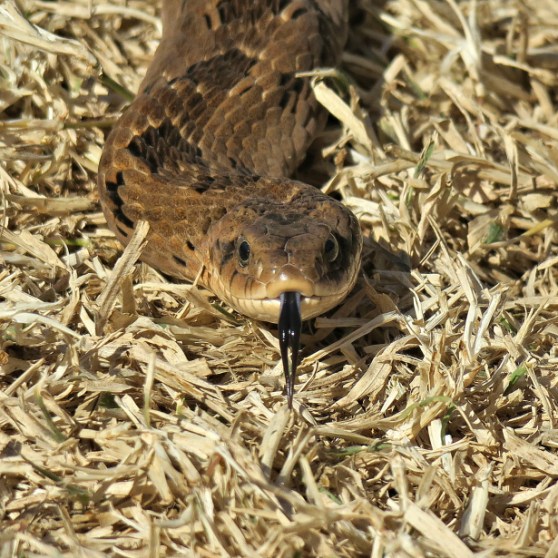
South Africa’s smaller reptiles are certainly no less dangerous. The following two images are not tame exhibits: I was told under no circumstances to lie prone on the ground to capture the photographs I would have liked to have taken, as I would stand no chance of getting away from an attack. With the venomous puff adder (Bitis arietans) accounting for more deaths than any other snake in Africa, I heeded the warning.
A bite from the night adder (Causus rhombeatus), though also venomous, is unlikely to fatal to adult humans – notwithstanding, I remained at a safe distance.
The striped kingfisher (Halcyon chelicuti) is not easy to catch on film – particularly during breakfast. Unlike the variants found in the UK, these eats mostly grasshoppers followed by other large insects. Small lizards, snakes and rodents are also occasionally taken. This juvenile spent a few precious moments perched 10m away from me, before continuing with its hunting. On this occasion, I was seen as the potential threat.
Today marks the 108th birthday of Gerda Taro, widely considered to be the first female photojournalist to cover war… she was also the first to die doing so. Google celebrated the day with the following Doodle:
Toro’s was born Gerda Pohorylle, in 1910, Stuttgart. As a Jew, the rise of the Nazi Party forced her out of Germany in 1934, separated from her family who she never saw again. Gerta moved to Paris where she began her career as a photojournalist, alongside André Friedmann, a man who she met in the French capital in 1935.
Fred Stein Archive/Getty Images (1936) Gerda Taro and Robert Capa, Paris.
Pohorylle and Friedmann began to publish works under the fictional American pseudonym of Robert Capa, a name he would take on as his own, whilst Gerta changed hers to Gerda Taro in homage to Japanese artist Taro Okamoto and Greta Garbo. The pair began their work in war photography in 1936 when they travelled to Barcelona to cover the Spanish Civil War, both producing photographs under the name Robert Capa. She not only photographed the violence of the time, but passionately campaigned against fascism that was rife across Europe.
Gerda Taro/The International Center of Photography (1936) Republican militiawoman training on the beach, outside Barcelona
Taro was covering the Battle of Brunete, near Madrid, in 1937 when tragedy struck and a car she was travelling in was hit by a tank. She died the next day due to her wounds at the age of just 26. This left Capa heart-broken and he never went on to marry. While photographing French manoeuvres in the Red River delta, Capa stepped on an anti-personnel mine and was killed on May 25 1954.
Taro and Capa both died while in the midst of the action, camera in hand, committed to their cause and to their trade.
Taro initially worked with a medium format 6 x 6 cm Old Standard Rolleiflex TLR camera with a non coated Carl Zeiss Jena Tessar 75mm f/3.5 lens. In the final five months of her life (possibly influenced by Capa´s chromed Leica III (Model F) and Summar 5 cm f/2 lens), Taro worked with a black lacquer Leica II (Model D) with Nickel Elmar 50mm f/3.5 lens. Further details HERE.
Born in Lancashire and now living in Salisbury, Magnum photographer Ian Berry‘s most recent work is far removed from his more widely known work in Apartheid South Africa. His study of the Salisbury Cathedral covers 800 years of art that fills the magnificent space. As Berry notes, “When built, these majestic medieval cathedrals were the art galleries of their day, none more so than Salisbury with its single style architecture of slender columns and soaring ceilings and its sculptures, larger than life on the west door depicting saints and bishops. On a more intimate scale in the Chapter House, carvings of ordinary people going about their business. What is so wonderful is that the mason who carved these small masterpieces used the faces of the workers around him to bring the frieze of daily life at that time, to vivid relief for everyone looking at them now.”
While his work covers many, varied facets of the art (and life) within the cathedral, I have focussed on three that illustrate some of the stained glass.
Ian Berry/Magnum Photos (2018) – Artist Michael Pendry’s installation of 2,500 white origami doves ‘fly’ the length of the nave. Salisbury Cathedral, Salisbury.
Ian Berry/Magnum Photos (2015) – The London Philharmonic Orchestra conducted by Jaime Martin rehearsing for that evening’s concert during Magna Carta year; the conductor and stained glass windows reflected in the still waters of the font.
Ian Berry/Magnum Photos (2017) – One of the permanently employed glass restorers shows a piece of medieval stained glass window he is working on.

 Wim Wenders (1977) They were made from the gut. Valley of the Gods, Utah.
 Wim Wenders (1973) Heinz.

 Today saw Nikon blast through the 100x threshold, announcing a camera with a lens almost twice as powerful as Canon’s best offering. The Nikoon Coolpix P1000 comes with an eyewatering 125x zoom lens (f/2.8-8.0) equivalent to a 24-3000mm lens. With both ED and Super ED elements, the lens accepts 77mm filters.
 With lens fully extended, the camera is 360mm (14″) long and weighs 1.4Kg (3.1 lbs). It has the same 16MP, 1/2.3″ sensor as its predecessor the P900 and offers an ISO range of 100-6400, together with RAW support.

 The early days of the RAF – 1914

 Rumours suggest that Nikon may jump the gun with a possible announcement in late July. There are two models purportedly, both with a new mirrorless mount and 5-axis in-body stabilization, allowing for smaller lenses. The flagship 45MP model will be around $4000 with 24-70mm kit lens and a 25MP version will be under $3000 with kit lens. These may ship as early as 23 August 2018.
 Far less has been rumoured about Canon’s entry into the fray. It is anticipated that it will release two full frame mirrorless cameras before mid-2019, with one being announced and on sale before the end of 2018. There is likely to be a 30.4MP flagship model and a 24MP secondary model. As to the camera mount, little is known besides the suggestion that there is a “sexy” solution to the EF mount problem.
 Russell Cook (2018) – Jon Messum with cartoon for his stained glass
 Russell Cook (2018) – Jon Messum with stained glass window




 Fred Stein Archive/Getty Images (1936) Gerda Taro and Robert Capa, Paris.
 Gerda Taro/The International Center of Photography (1936) Republican militiawoman training on the beach, outside Barcelona
 Ian Berry/Magnum Photos (2018) –
 Ian Berry/Magnum Photos (2017) – One of the permanently employed glass restorers shows a piece of medieval stained glass window he is working on.