Project Development

Henry Holiday


The stained glass windows I have most closely studied lie within the Chapel of St. Nicholas, which houses a magnificent series by pre-Raphaelite Henry Holiday.  At first, only the Chancel (the part of the Chapel where the Choir resides) had coloured windows, the rest of the Chapel simply having clear glass, but through time all thirteen windows were filled with his work.

Henry Holiday editedHenry Holiday (1839-1927) was an artist of great skill and many talents.  He was trained by William Cave Thomas in 1852, and two years later he entered the Royal Academy School.  He made progress with his drawing and painting and was greatly influenced by the Pre-Raphaelites.  Millais and Ruiskin both encouraged him, praising his painting, and he was on friendly terms with Rossetti, Burne-Jones and Holman Hunt.

Following commissioning, Henry Holiday produced a vidimus (below, left) for approval.  Once the design was approved, a full-sized cartoon was drawn for every ‘light’ or opening of the window.

This vidimus and window shows the story of the three holy children, from the Book of Daniel: Shadrak, Meshak & Abednego, who had be flung into a burning fiery furnace because they would not worship Nebuchadnezzar.

Text:
O all ye works of the Lord, bless ye the Lord.
Praise Him and magnify Him for ever.
Benedicite

M1 Wk7: Micro Project

Reflection


I have always maintained that the photography of stained glass is beset with difficulties.  Planning can help diminish these, but with the best will in the world, diverse and unexpected problems crop up particularly when working within the confines of tight time constraints.

I estimated that the micro project would take about two hours and in the second half of the week there was just one slot into which I could squeeze the shoot: early Saturday afternoon.  Prior to this, twice I visited the chapel to experiment and plan, but I opted not to bring a tripod on either occasion.  Friday afternoon’s visit was blessed with exquisite and constant light, but sadly Saturday saw skies filled with large snow-laden clouds and variable light.

Timing was far from perfect: Throughout Saturday afternoon, the chapel was being prepared for Sunday morning’s Confirmation Service – one of the biggest services of the year.  Consequently I was constantly at the mercy of interruptions from the cleaners, the Lay Chaplain, Chapel Wardens and numerous others.  Try as had as I might to complete the 36+ photographs without any internal light, each of the many people who entered the chapel during the two hours I was photographing, opted to turn on some, or usually all of the lights, causing huge difficulties with some of the more sensitive compositions.

Preparation for Sunday’s service precluded me from using any sort of platform to raise my position and access to the East Window is limited by the proximity of the alter.

The photo shoot highlighted numerous difficulties, many of which were previously known, but the most significant being depth of field.  In order to capture a small segment of a window, I was mostly shooting at 400mm at a distance of no more than 4m, whereas in the past I have shot using a n 85mm lens at a distance of about 7m.  All the shots at the top of the window were at a significant angle, resulting in images in which it was possible to have only a small area in sharp focus (most notable in image 23): possibly not a problem, but certainly not what I would have liked.  A further undesired consequence was the foreshortening of the image: the greater the height of the area being captured, the greater the degree of vertical compression, resulting in differences between my plans and the captured image.  A large alter immediately in front of the window made macro shots impossible as I could not manoeuvre the camera closer than 2m.

DCP_5619 (low res)Through the series of photographs, I tried hard to give an indication of the subject matter, the history of the window, the opulence of the figures depicted as well as some suggestion of the condition (both good and bad) of the window.  I believe that I met all of the rules, although I am not entirely sure that I was able to portray the window as an experience.  To provide greater flexibility, I shot just over 40 photographs, experimenting with the addition of some of the structure of the stained glass.  Perhaps I should have included more images such as this, which shows one of the strengthening bars, and also illustrates well the large dynamic range.  This project illustrates well the difficulties inherent in photographing these windows.  The pale green glass in particular proving very demanding to capture appropriately.  In photographs it can look either washed out or flat and dull grey-green, when in reality it has an almost golden component.  Confirmation, were it needed, for a photograph of stained glass to be a composition of numerous differently exposed segments.

Project Development

Digital removal of support bars


Henry Holiday cartoon windowRemoving the horizontal support bars from a stained glass window image is definitely contentious.  After all, the vidimus, (the approved design of a window; an example is shown to the left) will have included these metal bars – they are very much part of the design.  However, they do mask window details and while a necessary evil, do detract from the composition of the artwork.

I have worked hard to remove the support bars from each of the windows I have edited.  It is a laborious and time-consuming process, but so far I have been successful in this work and the results are pleasing.  However, thus far this removal has for the most part been straightforward with the support bars covering comparatively plain segments of the window.  Unfortunately this is not always the case, with some windows featuring support bars which cover intricate and complicated detail.

IMG_2927 CROP lr

In the portion of window above, the removal of the support bar would be straightforward where it covers the orange/red and blue material; the stair-runner would be rather more demanding as would the basket.  However, the construction of two dove’s heads in the absence of any reference material would be unbelievably difficult.

02 - Cropped - CROPI stand by my belief that the edited images are dramatically improved following the removal of the support bars.  Thus it remains my intention to remove them when and where possible.  Perhaps my choice of stained glass window within a chapel, where choice is available, should be driven to some extent by this factor.  Where this presents  an almost 03 - Completed - The Lord is my Refuge CROPimpossible editing challenge, such as the bird basket above, then it would seem appropriate to leave the support bars in situ.  Frustratingly, I am prompted to type this having spent in excess of 10 hours thwarted by one section of support bar within an image from which I had already removed 60% of the bars!

Into the sun…

Lack of cloud cover has been a problem


Several weeks of sunshine have been an absolute pleasure when working with children – my athletics squad have had uninterrupted track and field sessions that have resulted in a huge number of PB’s, fantastic results at their meetings and a record number qualifying to the National Championships.  Taking fifty 13-year old boys on a five-day adventure activities trip to the edge of Dartmoor was a doddle compared with the more usual cold a mizzle of the high moorland.  Sadly, it has not been very helpful where my project is concerned, but it has allowed me to consider other aspects of stained glass.

A look at the windows of the Chapel of St. Nicholas, bathed in glorious sunshine reveals a stunning richness to the colour palette. The combination of a warmer colour temperature and a more intense light give all colours a more vivid appearance, with the darker colours having greater depth and the more subtle skin tones having a healthy tan!  This made me think that I have perhaps been missing a trick in photographing stained glass windows only during bright, cloudy days.  Consequently I spent a morning photographing five of the windows.  It was not until I viewed them on a computer screen that I realised the problem with this approach: every single glass panel had an obvious shadow created by the calmes (strips of lead H shaped to hold the pieces of glass together).  While the palette is, perhaps, more attractive with the sunlight pouring through the left window, the dark shadow in the hair at the top of the head detracts from the image.

Unedited images taken in sunlight (left) and during cloud cover (right).

Waking to an overcast sky gave me the opportunity to re-shoot the windows, with the image to the right being the preferred skin tone of this particular batch of twenty image: providing a purer, perhaps more innocent face to the angel.

Project Development

Chapel of St. Nicholas – revisited


The Chapel of St. Nicholas was the starting point for my passion of stained glass windows.  Boasting thirteen beautiful windows by Henry Holiday, this jewel of Pre-Raphaelite excellence is a private chapel to which I have uninterrupted access.  A brief break in the uninterrupted sunshine of recent weeks provided me insufficient time to negotiate access at such short notice to one of the college chapels, so I took the chance to redo my very first stab at multiple exposure blending back in 2013.

I was tempted to use the same camera (Canon EOS-1D X), since I would be using the same lens (Canon EF 85mm f/1.2L II USM) but it seemed more sensible to maintain continuity across the project by using the EOS-1D X MkII.  My original batch we shot at f/3.2, but throughout the development of this project, I have opted to shoot a f/8.0 in an effort to hit the sweet-spot of the lens as well as to ensure that every part of the window is in sharp focus.  Much care has also been taken at the editing stage in working only with uncompressed images – such attention to detail was definitely lacking in 2013:

2013 (left) vs. 2018 (right)

Eighteen hours of image editing proved that my software skills have come a long way in five years and I am now more adept at removing the support bars, in addition to ensuring that subtle designs are included that I had previously omitted (the flower motif in the top section of the sword scabbard, for example).

With support bars (left) vs. edited image (right)

While a blog post does no justice to the window, nor indeed the editing, the finished image reminds me why I was first drawn to these windows.

Fight the Good Fight - NEW (low res)

Fight the Good Fight (Henry Holiday, 1906) Chapel of St. Nicholas

Project Development

Correcting years of damage


I remain ambivalent with regard to unnecessary alterations to the stained glass windows, although my intentions to create stand-alone art makes me inclined to correct cracks in glass, for example.  However I wanted to see how effectively I could restore more demanding damage.

The East window of the Chapel of St. Nicholas dates back to 1896 and is the largest work by Henry Holiday in the chapel.  Above the four lights is a roundel of Eunice and her son Timothy, which has sustained quite considerable weather-related damage over the past 120+ years, which is most obvious on the skin tones and in particular the two faces – why start with something simple?!

While this remains work in progress, I am particularly pleased with the results I have achieved on Eunice’s face.

There is still a long way to go with many of the individual pieces of stained glass.  Both items of clothing above have had an initial tidy-up, but could be further improved – it is all just a matter of available time.  With me heading off on a school trip to South Africa for the next two weeks, time is short!

The roundel is flanked by angels.  Oddly, the angel on the left was in pristine condition whereas the other required extensive post production work on each skin-coloured piece of glass.  Below is the semi-complete work:

Eunice & Timothy - repaired NEW (low res)


UPDATE: August 01, 2018


Another 10+ hours of editing has produced a more complete restoration, although I am less than satisfied with the work.  Some of the damage left minimal original material with which to work, making the reproduction of accurate textures very difficult.

The format of this blog better lends itself to a cropped view of the roundel of Eunice and Timothy, so below is a before and after animated GIF:

Eunice and Timothy GIF

Eunice and Timothy (Henry Holiday, 1896) Chapel of St. Nicholas

Project Development

Plain English & the Chapel of St. Nicholas


Feedback on my initial Work in Progress Portfolio suggested  the ‘it may be worth exploring the possibility of showing details or fragments in order to communicate other aspects of their importance.’ 

While I am confident that the Plain English Campaign could host a symposium on English language and its use in art critique, I rather relished investigating this suggestion and hope that my interpretation of its meaning is true to the author.  To that end, I have investigated the finer detail of the stained glass in order to demonstrate the various associated processes – something already done in part, but perhaps overlooked, during Module 1: Three dimensions? in which I demonstrated the unexpected three-dimensional nature of parts of some of the lights, with two layers of painted glass providing greater depth as well as increased saturation to areas of the installation:

800x800 DCP_8432d

With illumination being so critical to stained glass window photography, I conducted numerous visits to the Chapel of St. Nicholas covering most lighting conditions, (overcast; partially cloudy, clear skies; morning sun; midday sun; afternoon sun and evening sun). in order to find the most opportune time to demonstrate best the macro world of stained glass.  Countless hours of lab time spent examining assorted geological samples during my graduate studies taught me that oblique illumination is typically best for revealing the rather more hidden stories.  Stained glass windows typically found on all walls of places of worship – certainly the case for the Chapel of St. Nicholas, but on a clear day, the late-afternoon/early-evening sun resulted in the most revealing illumination of the north and south aspects.

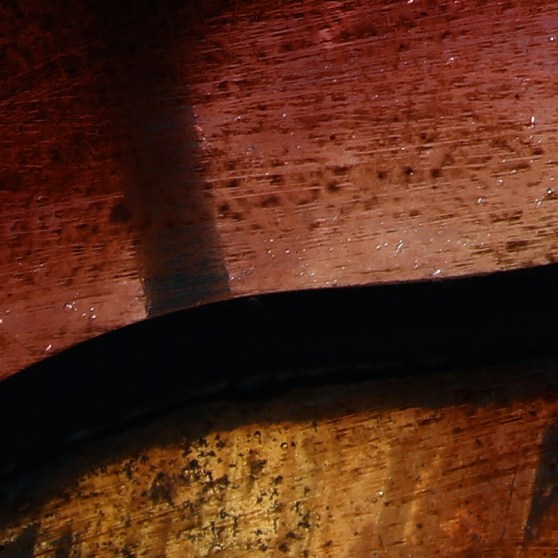
Some 140+ images later, interesting an revealing detail of the quality of the glass, nature of the painting, together with the structure of the windows became more apparent.  I rather like the images and undoubtedly, these abstract, out of context, colour panels could be displayed in their own right.


The glass clearly shows its age with impurities, inclusions and many vesicles throughout:

Fine relieving (removal of paint from the surface of the glass prior to firing) formed the final process.  In this case needlework was used:

The painting at times is far more akin to pen and ink, with precise, controlled lines often not more than 1mm thick, providing the patterns and textures:

800x800 DCP_8458

In close-up, the order of events can also be identified particularly when looking at pale washes of colour… bold lines – shading – colour – dry brush:

800x800 DCP_8451c

Beyond the glass, the quality of the metalwork is exquisite, with the calmes that hold together the pieces of glass being soldered together very cleanly and precisely:

Calmes.jpg


Creative interpretation


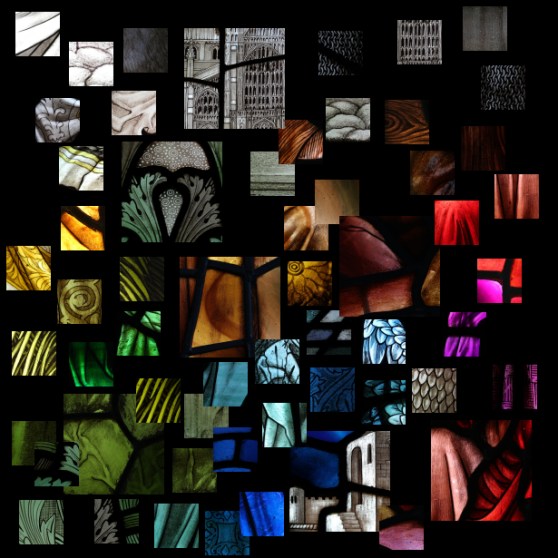
This micro-project also presented the opportunity to be ‘creative’ with the exquisite artwork… undoubtedly Henry Holiday will be turning in his grave.

12x12 composition (low res)

Contemporary Tiles

NEW Composition (low res)

Abstract Tiles

Project Development

Chapel of St. Nicholas


When photographing the Chapel of St. Nicholas in early July, I was undecided which light would be best to edit, so with conditions being ideal, I photographed a selection.

The completed image below strikes me as being rather dark, although as I recall, this was the case particularly in comparison with Fight the Good Fight, for example.  I have yet to take a copy to the chapel for comparison and possible re-editing.

One omission from most of the windows or lights that I edit is the inscription.  This window was given by the parents after the death of their son.

The inscription reads:

In Loving Memory of EDWARD HORACE PERCIVAL, who died at Summer Fields March 9, 1900, added 14.

The boy in the image is apparently a likeness of Edward.

St. Nicholas - Be Ye Kind One to Another (low res)

Be Ye Kind One to Another (Henry Holiday, 1901) Chapel of St. Nicholas

Project Development

Chapel of St. Nicholas – rose tinted glasses?


St. Nicholas - Be Ye Kind One to Another GIF.gifToday afforded me a moment to call in on the Chapel of St. Nicholas in order to compare my rendering of Be Ye Kind One to Another with the installation itself.

The concerns I had about the darkness of my image were well founded, and interestingly I had again oversaturated the reds and browns (as was the case with the Harris Manchester College Chapel light Courage).  Perhaps there is some truth to the  rose tinted glasses idiom?!

Such changes were quite easy to correct as was some fine detail in the colouring of the text and punctuation.  The animated GIF to the left demonstrates these subtle changes in a 2-second cycle (but does sacrifice quality):

There is a lot of quality loss in a GIF, so below is a JPEG of the final re-edited image:

St. Nicholas - Be Ye Kind One to Another v2 (low res).jpg

Be Ye Kind One to Another (Henry Holiday, 1901)

Project Development

Contemporary Tiles animated


While being creative with Henry Holiday’s glasswork, I was keen to see if there were any other ways that I could put to use the concept… here’s one:

Contemporary Tiles