M2 Wk1: Strategies of Looking

Week 1: Independent Reflection


In keeping with much of Module 2, my ability to follow the prescribed path will be determined by my work commitments during the second half of the busiest term of the year in a boarding school.  It is almost certain that I will be unable to carry out any photographic work specific to my project until early-mid July.  However, I will be carrying out assorted other photographic tasks relating to my work, which as likely to be the focus of these initial blogs.  Thus I will maintain my CRJ and carry out weekly Independent Reflections, but they may not tick all of the anticipated boxes.


In the academic world of prep. school education, we have come to exam week for all but those who have succeeded in passing into their future schools by way of scholarship entrance.  For that lucky group, the majority of the week was spent in the Somme Battlefields, learning of the lives and deaths of Old Boys from the school who fought in The Great War.

My part was, as always, to recorded images of the sites visited for the school’s social media, its archives, and also for a post-visit project being put together by the boys.  In addition, I provided the technical background to the weapons; the intricacies of warfare, and advice on identifying the various artefacts found on the field trip.

Sadly GDPR precludes the inclusion of some rather poignant images, but below are some that are rather more generic…

IMG_5046 (low res)IMG_5060 (low res)

My current practice:  For this week it has been predominantly one of reportage photography.  This is probably my preferred discipline or at least, the discipline with which I feel most at home.

What did I do / feedback received / response to feedback:  Throughout the week, my photographs were tailored to different audiences.  The school required something akin to picture postcards of the trip for social media purposes.  The image gallery for the boys’ projects necessitated views of each site visited; images of any significant artefacts and images of any war graves of our Old Boys (something also required by the Archives).  Beyond this, I am always keen to improve the composition of pre-existing archive images (I have visited and documented battlefield sites across the globe on some 20+ school trips) and also bolster my own portfolio.  The feedback was entirely positive largely because I have a good long-term understanding of the needs of the various target audiences.  However, from my own point of view, I am still hunting that ‘perfect’, if clichéd, image of poppies in a field – typically thwarted by the time constraints of supervising children.

My methodology:  This is something to which I rarely give a moment’s thought.  So much of photography has to be instinctive and as such, the methodologies of my work are inclined to be almost subconscious.   At least I think that is true of my methodologies, but to ensure that I can tackle this requisite appropriately, I have just Googled ‘photographic methodology’ which produced the following pretentious drivel…

Photography-led research demands a methodology that embraces the implicit in order to generate results that inform practice by making unconscious mental constructs explicit: i.e. a methodology that is able to support an objective theory utilising a subjective medium.

Notwithstanding, I will take a retrospective stab at the methodologies I have used – throughout I hold tight to the importance of composition, with the rule of thirds being a significant consideration whenever possible.  I am always conscious that any faces seen in images for school use should look appropriately for the situation: two children laughing while in a Commonwealth War Graves Commission cemetery would not make a usable image, for example.  Because almost all of my work is candid, the wastage is not insignificant – children are never predictable, and where composition is concerned, they are rarely where you want them to be.  So often I miss the ‘perfect’ shot, because as a school master first, I am dealing with a child, rather than looking through a viewfinder.

The forms my project / photographs could take moving forward:  For this week’s work, I am unable to relate the comments directly to my project.  However, thinking of the images I have taken, I know that some will feature in a new gallery that I am creating along a corridor within the school.  For ease of updating and to ensure a reasonable level of child-proofing, the picture frames will be permanently mounted clip-frames typically associated with commercial point-of-sale applications.


Reflection on Week 1 Forum: Looking Back

I much enjoyed this mini-project – it gave a pleasing, holistic glimpse at two aspects of my work that coincide so well.  The post was well received by the small number of colleagues who commented, but feedback was unable to prompt any response from me besides a warm internal glow.

Reflection on Week 1 Activity: Place Over Time

Another enjoyable, if frantic mini-project.  With a tiny window of availability for this work, I had to think quickly and clearly on what I could achieve in a matter of hours.  The results were pleasingly true to Ann Sungseok’s composition, although I took my work to a third level of image which may have been superfluous – the largest image was certainly the most challenging!  I am very happy with the outcome and the idiosyncrasies of the lenses used happened to play to my favour.

It was useful to receive feedback relating to the need for more technical information – rather a foolish oversight on my part.  Such information I duly added and I now take much more care in commenting upon this important aspect of my work.

M2 Wk2: Strategies of Mediation

Week 2: Independent Reflection


Can a photograph be considered finished?

My research project is based entirely on the copying of other artist’s work. Driven by the wants of Oxford University and the Colleges, whose permission I require in order to photography their stained glass windows, my intentions are to represent accurately and precisely the stained glass found within the chapels of Oxford, in contrast to almost all existing reproductions of the windows.  Consequently, the published results need to be truthfully representative and with minimal opportunity to be interpretative.  That said I am disinclined to wish to reinterpret works of world renowned artists – I lack the arrogance to think that I could produce something that was ever anything more than a bastardisation of the excellence exhibited by  William Morris, Henry Holiday, Dante Gabriel Rossetti, Edward Burne-Jones, et al.

With the majority of artists whose work I am photographing no longer alive, I am happy to consider their artwork ‘finished’ – perhaps ‘completed’ would be a better word.  However, the nature of stained glass is such that it is brought to life by an ever changing medium: daylight.  Their appearance is changed dramatically by the weather, seasons and time of day, but equally by foliage and the ever-changing construction of buildings around them.  If my aim is to recreate perfectly an image of a stained glass window, I believe that this can only be done with the window removed, cleaned and backlit by a uniform daylight-balanced light.  Until that is achieved, none of my photographs can be considered truly representative and as such, until then , the work cannot be considered ‘finished’.  The best I can achieve is to aim to photograph windows in the optimum light: bright, but overcast conditions where they are lit by diffused, full-spectrum light (a colour temperature around 6500K).

I have already photographed some of the lights within Harris Manchester College, but am yet to focus upon any of The Days of Creation series (1895-1899) by Edward Burne-Jones.  In keeping with almost all stained glass, prior to commissioning drawings and watercolours were produced, but in this case, they themselves became famous works of art.  From 1870 to 1876, Burne-Jones’ composed using various media depictions of God’s six days of creation.  He designed modelli in pencil cartoons for watercolour paintings on gouache, containing shell gold and platinum paint.  In turn, these modelli were employed to compose stained glass windows and porcelain tiles for several chapels.  When I do revisit HMC, it will certainly be interesting to see the similarities and differences between my photographs of these stained glass windows and Burne-Jones’ watercolours and ceramic tiles.


Following my research this week, I will try to find the time to investigating how significant is the impact of differing daylight on a stained glass window.  It would be fascinating to make such a study throughout the seasons of a year, but this would be far from practical or practicable.  However, more achievable is a day long study which might disprove my beliefs that I should only photograph the windows in bright, but overcast conditions.


Thus far, I have only viewed my stained glass window images on computer screens, in a book or printed on 310gsm standard fine art paper.  Despite the nature of the originals, I am very much taken by the art paper prints.  However, it would seem foolhardy not to investigate assorted backlit options.

M2 Wk6: Exhibition Guidance

Week 6: Independent Reflection


For the first time in this Module, I have had the chance to focus upon my research project.  Rather than just bolstering the portfolio, I spent time investigating the most appropriate light conditions and it was interesting to see just how dramatically the colours of a stained glass window change.  While the warmer, more vibrant colours of a cloudless sky produced preferable image colours, it had the negative effect of introducing shadow into each pane of glass.  Consequently, the light of a bright, but overcast day was best:  it was reassuring to confirm that I had been photographing the chapel windows in the most appropriate conditions thus far.

I also chose this time to revisit the first stained glass window that I photographed in 2013, using multiple exposure blending.  Aware of the limited time that I have available to my research project during this Module, it was concerning that the post-production editing took eighteen hours.  However, the this produced and image of markedly better quality than the 2013 original and more importantly, the finished image is more true to the original.  This advancement is thanks to a number of changes… an new camera body; a better tripod head and greatly improved image editing technique.

It is clearly the case that all aspect of my work have improved over the past five years and I am confident that through this project I will see further improvements.  It would be wonderful to discover a most efficient method of post-production, although realistically I cannot see this diminishing greatly.


Thinking About Spaces

With a plans to host an exhibition of my work, it is clear that my studies would have benefited from more time being spent on this week’s topic.

I am very much aware that there is a huge difference between an appropriate space for exhibiting and a space that will draw the crowds (perhaps unwittingly).  Perhaps the most ideal location for hosting an exhibition portraying the stained glass windows of Oxford’s chapels would be within a chapel.  This could be easily achieved in St. Luke’s Chapel, now part of Oxford University’s Conference & Events venue portfolio: Virtual Tour.

stlukesexhibitionsetting2__venue

While a stunning and perfectly themed location, capable of accommodating 70+ people for an exhibition, sadly St. Luke’s is a little out of the way and would only attract those who intended to visit the exhibition.  Passing tourist traffic is not at all high and it is only open when a client pays for it to be open.

To maximise footfall, the location of choice would be Aiden Meller Gallery on Turl Street in the centre of Oxford.  An almost-pedestrian street popular with tourists and locals alike.  Working in my favour, it has already hosted an exhibition in 2017 of Pre-Raphaelite cartoons for stained glass.  Importantly, the gallery is also a dealership, used to marketing and selling art work, and is exquisitely capable of hosting exhibitions to the very highest level with knowledgeable curators on site.

Aidan Meller shopfront

Google Street View (2017) Aiden Meller Gallery, Turl Street, Oxford

While neither of these locations are any great distance from me (each being less than 3km away), right on my doorstep is The North Wall, just 300m away.  Part of St. Edward’s School and just a few meters away from their chapel, The North Wall Arts Centre is a flexible, multi-purpose arts complex which contains a theatre, drama studio, dance studio and art gallery.  Located in the most affluent part of Oxford, this would certainly be more readily visited than St. Luke’s Chapel, but falls outside the typical stamping ground of visiting tourists.  However, The North Wall is very accommodating, always open to visitors and has a resident curator.

St. Edwards - North Wall (low res)


In addition to my project work, this week saw me attending the Athletics World Cup at the Queen Elizabeth Stadium in London.  As I was purely spectating, this was my first visit there without a full frame camera and white lens, relying instead on the Canon G3 X.  It was inevitable that the combination of smaller sensor size and small aperture lens would result in less crisp images, but with static shots the comparative lack of quality was not very noticeable.  However, unsurprisingly, it struggled rather more with action shots – that said, the results were far from disappointing.

M2 Wk8: Workshop Guidance

Week 8: Independent Reflection


Throughout my professional teaching career, I have taught photography as an extracurricular activity.  Back in the 90’s, in addition to composition and the practical camera-based skills, I would teach darkroom technique – something I do very much miss in the digital age.

Image editing is firmly on my teaching curriculum and is very much enjoyed by the pupils.  School trips to South Africa lend themselves to large amounts of photography and more often than not this gives me the chance to provide tuition in the field.  However, the tuition is not all one-way: my skills are poor when it comes to video work, yet this seems to be an area in which teenagers are drawn and their skills are often incredibly impressive, so I always take the opportunity to learn from their expertise.  They have the advantage of instant feedback and almost limitless online instruction – I wonder where my photographic skills would be had I had similar opportunity?!

I have been asked by a good friend to provide a (paid for) half-day photographic workshop in Oxford for a colleague of theirs who is a keen amateur photographer wanting to progress his skills further.  This would be an opportunity for him to learn some new techniques while also benefitting from ‘playing’ with my assorted ‘pro’ kit.  Conveniently, we both used Canon making the process a little simpler.  I have never done such a thing before and know that it will require me to spend a good deal of time planning routes and locations, as well as asking permissions to photograph certain locations.  I would be extraordinarily anxious about it were it not for the fact that I am having to work 15+ hour days playing catch-up on my MA and have been doing so every available day of the summer.


Having only just returned from a two-week school trip, I have huge areas of catch-up to address in the knowledge that I am taking my summer holiday in a week’s time.  The coming week will have to be spent both taking project photographs and processing them.  However, I need to rationalise this, since every completed image typically represents 2-3 days of work and I know that the last Oral Presentation occupied me solidly for 8 days!  Very little time and huge amounts to do.

M2 Wk3: Strategies of Sharing

Week 3: Independent Reflection


This reflection seems out of chronological order, however, it contains feedback relating to a school trip only recently completed…

For this week’s activity, I have to accept that I was unable to commit to the precise guidelines of the task.  However, a zine (of sorts) was produced following appropriate collaboration.

Having worked in education for 25 years, I am well used to gleaning information from children and using that as the starting point for work.  In that respect, the ‘Making Zines’ activity was no different and I openly embraced the collaboration with the children.

How well the task was tackled was comparatively simple to ascertain:  during the South Africa trip there were still countless questions – such is the nature of children, but there were very few to which the response needed to be anything other than ‘have a look in the book’.  Of course, the reality was that I still gave the answers to any such questions.  Such a publication provided a useful reference for the children and gave reassurance to the parents that the trip was being managed by competent, experienced professionals.

The zine was produced using Microsoft Publisher – not an industry standard, but certainly an educational standard.  Producing high quality publications helps me directly in my teaching of desktop publishing, but also helps the children realise what can be achieved (as well as the high standards that I have).  In that respect, this collaborative work helps all involved parties.

The concept, design and realisation of this zine was done entirely in-school using normal educational procedures.  The welfare and protection of children is so entrenched within any such activity that there is no chance of ‘taking advantage’ of the subjects, thus there are no ethical concerns.


During Week 3, the only photographic work I carried out was at the Regional Athletics Championships.  With a sizable team to Manage, my photographs were rather few and far between, and sadly GDPR constraints dramatically limit what I can publish here.

M2 Wk7: Publication Guidance

Week 7: Independent Reflection


I have always loved books – another trait I gained from my Father, former Head of English and former Headmaster who collected T.E. Lawrence 1st Editions.  He used to read Tolkien’s books to me at bedtime when I was a child, and as a result I now collect Tolkien 1st Editions – somewhat of a costly hobby!  The ‘shelfies’ activity reflects some of my passion for books and publications.

I absolutely love producing publications and have a number under my belt, primarily related to the school at which I work.  I am very much a control freak where this is concerned, insisting on handling every single part of the process up until I hand over the publishable PDF to one of my trusted commercial printers.  The most recent work was for a school trip to South Africa – I am already working on the 2019 edition having overlooked Apartheid and a section on reptiles in this one: South African Adventure

Time willing, my project will feature a publication either as a guide to compliment an exhibition, and/or a tourist guide to the stained glass of Oxford chapels.  While there are two out of print similar publications, it seems about time for something more up-to-date.  The 1979 publication contains no images and the 1994 publication has rather too many tiny images – albeit of pleasingly good quality.

  • Jones, A.T. (1979) The Stained Glass of Oxford. Oxford, ZiPrint Parchment (Oxford) Ltd.
  • Opher, P. (1994) Oxford Town Trail – Stained Glass. Oxford, Heritage Tours Publications.

Of course, today a publication does not have to be a physical entity and Oxford already has a number of self-guided tours driven by mobile phones:

Perhaps this is a more sensible route to take where a tourist guide is concerned, saving on having to rely upon outlets stocking and selling a guide book.  The advantage of using a mobile device is that it can manage the navigation from location to location: too few people seem to cope with printed maps!

Whatever publication path I decide to follow, I will want to produce something that is well designed and pleasing on the eye.  I see neither point nor reason for a poorly produced publication.

It would make sense for a tourist guide to follow a sensible trail, minimising the distances involved (not that these are huge) and maximising the visual impact both in terms of the book and the chapels.  This would be an occasion to omit less appealing locations – not least because it would take many hours to visit all 40+ chapels!


I have yet to carry out the Week 7 Forum: Sorting Images mini-project, but hope that I might have a moment to address this prior to the submission deadline.


I hardly need any opportunity to prompt me to create a publication, so it has always been a plan to follow that route as at least part of my project.  Rationalising the various options has proved helpful.  Most of my publications have been perfect bound which looks very tidy as a finished article, but is definitely not the best solution should a double page spread be desired as it is difficult to open such a book flat.  Careful consideration will be needed as to the size and format of any publication.

Photographic work for my project development during Week 7 has been non-existent as a result of being located in South Africa. Further information HERE.

M2 Wk9: Production

Week 9: Independent Reflection


It is a good thing that I have a holiday coming up as my contributions to the research project have occupied the past week solidly.  I chose only to visit two locations as well as conducting some experimental heresy on the stained glass windows of Henry Holiday that I photographed earlier this month.

At all three locations visited in July, I opted to photograph in its entirety multi-light windows.  In situ these always look mightily impressive on account of their size and their complexity.  Sadly in post-production these become a nightmare particularly when it comes to the removal of support bars.  The William Weatherley window in St. Edwards Chapel was proof in point: not a huge window, consisting of just three lights with reasonably straightforward artwork.  It took just over five hours to complete the initial editing and then a further 14-15 hours to remove the support bars (illustrated in the before and after GIF below).  I am happy with the results and hold fast to the idea that this makes for a better image, but where time is precious, it can be tricky to justify spending so much additional time on a single image.

St. Edwards - William Weatherley (GIF 02)

I have experimented with two areas of extension work in recent weeks.  The first was conducting extensive digital restoration on a roundel flanked by angels, which although each is a small light, took just over ten hours once the initial editing was completed.  For enhanced clarity below is the roundel on its own:

Eunice and Timothy GIF

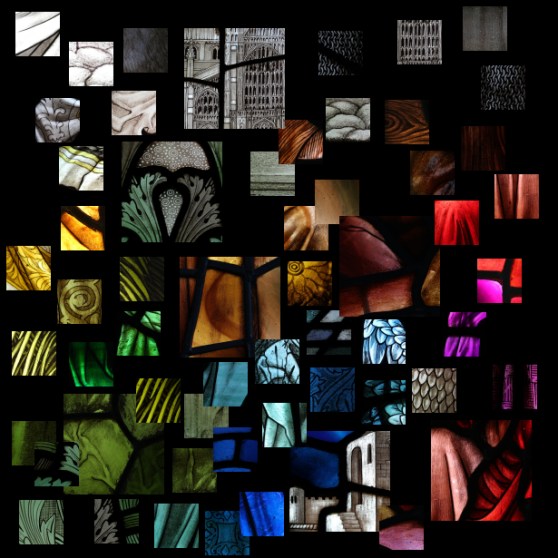
The next area of ‘extension’ was in the creation of contemporary images reworked from a very large sequence of close-up photographs of stained glass windows.  I am not convinced by the images, but they are growing on me in mould-on-cheese way.  While I definitely prefer the structured 12×12 grid, I quite like the way that your eyes travel around the more abstract image.  I am sure that I will experiment further with such imagery, but it stands clearly separate from my research project proposals.

NEW Composition (low res)12x12 composition (low res)

M2 Wk4: Strategies of Freedom

Week 4: Independent Reflection


It was interesting to consider (very briefly) the philosophy of photography in relation to ‘photographic images NOT taken by a human’ and as I type this, another example pertinent to my work springs to mind, so please do indulge me on a slight deviation from the planned blog…

Forum: Human?


Photo finish technology has a history dating back to the 1940’s, and its use in athletics is now so commonplace that it features in a number of the junior school meetings to which I take competitors.  Indeed, when coaching, if I am required to record alone the times of multiple athletes in a track event, I use a mobile phone app (SprintTimer) that is a fully fledged photo finish solution in my hands.

Photo finish technology allows officials to discriminate between multiple competitors crossing the finish line at nearly the same time.  It is capable of taking 3000+ images per second in order to separate apparent dead heats.  Consequently, it is not uncommon for two competitors to have the same time (recorded to 1/100th second), yet be separated in race position by a photo finish that has a timing accuracy some 30+ times more accurate.

The Omega high-speed video unit below is typical of those used in International Athletics (this being the unit used at the Athletics World Cup, London in July).  The resulting image is familiar to athletes and coaches, but is decidedly unusual as a result of the process used to create the image.  Photo-finish cameras use strip photography, in which a camera is aimed at the finish line from an elevated position. It captures only the sequence of events on that line in the vertical dimension.  Every part of each racer’s body is shown as it appeared the moment it crossed the line; anything stationary is represented as a horizontal streak.  The horizontal position represents time, and time markings along the bottom of the photo can be used to find the exact crossing time of any racer.  The high angle allows judges to see the position of every racer in relation to the others.

The final image often shows a solid white background, which is a continuous scan of the painted finish line.  Racers may appear distorted based on the movement of their limbs and heads as they cross the line; limbs are elongated where they remain static or move backwards in relation to the slit-shutter, or truncated if they move faster than the film moving past the slit.

IMG_5339 (low res)Photo finish

The photo finish image shows Lawrence Clarke winning his heat in the 110m hurdles at the 2014 FBK Games in Hengelo.  As it was captured by a machine, I presume it needs no credit!


Getting back on track…

Relationship between me and my cameras:  My very first SLR was a Canon T70, since when I have only ever used Canon SLRs.  I have moved through the ranks of their professional bodies since the mid 1990’s, when I was using the Canon T90.  Since then, the physical feel and layout of all Canon professional bodies has remained essentially the same, with their design evolving thanks to a close working relationship between Canon and its professional photographers.  As a result, my current main body (EOS-1D X Mark II) fits like a glove thanks to almost 30 years of muscle memory allowing me to use the camera without conscious effort.  I have a friend who uses Nikon kit and bizarre as it sounds, I simply cannot use his cameras effectively – to me they feel odd and unintuitive.  Of course this is not actually the case, but such is the conflict with muscle memory.  Likewise, when I use my Canon G3 X, although becoming more routine, I do still find myself fighting with it resulting in some missed shots.

When does responsibility become a consideration in my approach:  I would hope that I am responsible in all of my photography at many different levels.  I hold an up to date First Aid at Work qualification and carry a first aid kit within my camera bag – safety and welfare would always come first.  Woking long-term with children requires total and unequivocal responsibility first – photography always has to come second.  I have been fortunate enough to teach the children of various A-list celebrities as well as royalty.  This has presented many photographic opportunities that could have been exploited, but not once have I done this – again, my responsibility and loyalty is to my work and the care of the children in my charge.

Can another photographer do what I do /  could I be more original?:  One of the driving forces behind my chosen research project was the woeful lack of good quality images of stained glass.  Indeed it is almost impossible to find any.  I am confident that anyone could do what I do… I am a human carrying out a task and it would be arrogant to presume that I am unique in being able to do what I do.  However, the huge dynamic range found in stained glass windows makes it something that cannot be photographed well by just pointing and shooting – there is a lot of consideration, planning and post-production required.  Perhaps most people simply cannot be bother with that.  It is my belief that the work I am doing with stained glass is currently unique and therefore cannot be more original.  Of course, the reality is that I am doing no more than copying someone else’s art work – an argument that could be levelled at a number of photographic disciplines.

Am I just another ‘button pusher’?:  I would hope that my attention to detail combined with the methodologies I employ label me as a photographer rather than a ‘button pusher’.  Knowledge of my camera; an understanding of light, depth of field, exposure,  perspective and composition, together with post-production skills separate me (I hope!) from the happy snapper.


Experience of the week’s activities:  Happenchance provided me with a couple shots at the ‘Hands off!’ activity, both of which I much enjoyed.  Clearly it is a good thing to put down the go-to tools and push the bounds with less familiar kit.  I was remined of an A-Level photography project that tied me to a fixed focal length lens, having been well used to zoom lenses.  After a short while I became far more at ease with the subject matter because I did not waste time zooming in and out – I had to move to the most appropriate locations.

I was very pleasantly surprised with the quality of the close-up work using the iPhone 7’s RedDotCam app: viewing in mono, real-time did change my choice of subject and composition.  While the inevitable limitations of something as simple as a mobile phone’s built-in camera could be frustrating, these were comparatively easy to work around.  I am only saddened that the app does not work on my iPhone X.

Reconsiderations to the core methodology of my project:  This has been another week where work commitments have precluded any project development.  However, it is something that routinely occupies my mind – largely through the anxiety and stress of being able to commit time to it!  It concerns me that I might struggle to photograph (successfully) all of Oxford’s chapels.  More significantly, my plan to include an image of (at least) one stained glass window from every chapel will inevitably require me to commit time, effort and money to some images that might be better left out of an exhibition or book.  I am not very good at compromising my high standards, so that inevitability is going to need careful consideration.

The forms my project / photographs could take moving forward:  It remains my intention to present my work as an exhibition and I am very happy with a selection of double-mounted prints that I have had produced to tout around Oxford’s galleries. The work I carried out in Week 3, producing a travel guide to South Africa reminded me just how much I enjoy desktop publishing. The publication of an accompanying exhibition guide book and/or a visitor’s guide to Oxford’s chapels would be a pleasure to edit and produce and I am well used to dealing with a number of Oxford’s commercial printers.

M3 Wk2: You are a business

Week 2: Independent Reflection


This has been a week where necessity had placed project-related practical work on hold.  However, I have sourced some useful publications to which I have committed time in the evenings…

Waters, W. (2012) Angels & Icons Pre-Raphaelite Stained Glass 1850-1870. Worcester: Seraphim Press Ltd. (Photography: Carew-Cox, A.)

Angels & Icons.jpgThis stunning 368-page hardback came direct from the photographer and represents nine years of research by author William Walters.  The detail is impressive and it has already proved its worth in helping with my research.  Possibly more importantly and certainly more uniquely within this field, it is illustrated throughout with exquisite images taken by photographer Alastair Carew-Cox.

I have been in communication with Alastair a few times with regard to his work.   For Angels & Icons he used 5″x4″ film and a plate camera to correct perspective.  However, in his most recent publication Damozels & Deities, in addition to plate he has used high end digital with tilt and shift lenses.  Because of the academic importance of the publications, he has to photograph what is actually in front of him, warts and all.  Consequently, unlike my images, his receive minimal post production, with the support bars, blemished and damage, etc., left in.

Volume three of the series is currently being researched and photographed, featuring far more of the works of Henry Holiday – a favourite artist of both of us.


Lifelines 12With a number of my recent site visits featuring the works of Edward Burne-Jones, another book purchase was also by William Walters:

Waters, W. (1973) Burne-Jones: An Illustrated Life of Sir Edward Burne-Jones 1833-1898. Aylesbury, Shire Publications Ltd.

One of the earlier publications by Walters, this 48-page small paperback is illustrated throughout in black and white.  It provides an interesting life story of Burne-Jones, but sadly (for me) only touches on his stained glass work, focusing instead more on his watercolours and pencil drawings.


Rather less of an easy read and substantially harder to source, was one of Henry Holiday’s books:

Holiday, H. (1914) Reminiscences of My Life. London, William Heinemann.

I was hoping that this autobiography would mention some of Holiday’s works for the Chapel of St. Nicholas, but sadly there is no reference at all!  I outlines the varied and numerous interests of the artist and in particular his involvement with the Pre-Raphaelites,  and is illustrated with his work.  Thus far I have only dipped into the pages, having prioritised work, research and sleep ahead of the 465 pages!

M3 Wk3: The digital new possibilities

Week 3: Independent Reflection


Instagram:

The account has taken shape quite well: dpplimited, but it strikes me as odd that there is no option to ‘invite’ followers within Instagram.

With hindsight, creating the account and adding 27 images prior to any tagging or attempts to attract custom may have been an error.  A drip-feed of those images would have made better sense.  I am also regretting the choice of a layout that requires posts three-at-a-time to be added – this makes the process of posting far more involved and not always as instant as I would like, since I have to wait until I have three appropriate images to add.    However, by the end of the week the account was being followed by at least 30 people.

I question the usefulness of Instagram as a business tool for my photography… Instagram predominates on mobile platforms, with images being viewed small-scale.  With only 10% of Instagram users being over 35, it seems probable that the vast majority on Instagram would be disinterested in stained glass windows.


Image Virus:

I have not yet ventured into the image virus foray, but stand by the variation of investigating I mooted, using the power of the World Wild Web to help the Kodak Junior No.1A images.