M2 Wk4: Strategies of Freedom

Forum: Human?


Photographic images NOT made by a human… are humans truly not involved? 

In my twilight years, as I lounge on the veranda of a retirement home, I am confident that I will bore the socks of my contemporaries, as I postulate photography’s philosophical frivolities.  While time is significantly more precious, I will move straight past the semantics of whether a camera or an operator takes a photograph.  However, this Forum did inspire me to conduct research in order to reconfirm my belief that no natural entity is capable of recording an image… therefore all photographs are ultimately made by humans as cameras (and all such recording devices) are man-made.

David Slater’s infamous ‘black macaque self-portrait’ has received far too many column inches to be included here, but throughout photographic history far more technically significant photographs have been taken by animals: that is to say, the animal has triggered the shutter.

It was Eadweard Muybridge who pioneered what we now refer to as ‘camera traps’, using wires that when tripped, trigger the shutter of a camera.  While he can be attributed to a host of fascinating motion studies, and his stop-motion technique was an early form of animation that helped pave the way for the motion-picture industry, it was a wager that first brought him to the attention of the public:

The Horse in Motion.gif

Eadweard Muybridge (1878) The Horse in Motion, Palo Alto

When a horse trots or gallops, does it ever become fully airborne?  This was the question photographer Eadweard Muybridge set out to answer in 1878.  Railroad tycoon and former California governor Leland Stanford was convinced the answer was yes and commissioned Muybridge to provide proof.  Muybridge developed a way to take photos with an exposure lasting a fraction of a second and, with reporters as witnesses, arranged 12 cameras along a track on Stanford’s estate.

As a horse sped by, it tripped wires connected to the cameras, which took 12 photos in rapid succession.  Muybridge developed the images on site and, in the frames, revealed that a horse is completely aloft with its hooves tucked underneath it for a brief moment during a stride.  The revelation, imperceptible to the naked eye but apparent through photography, marked a new purpose for the medium: it could capture truth through technology.

130 years later, camera traps were again in the public eye as a result of the Grand Title Winner 2008, Wildlife Photographer of the Year.  This proved a contentious decision, as it was argued that a camera triggered by the animal in photograph should not earn such a prestigious title for the owner of the photographic equipment.  However, the background to Steve Winter’s exceptional image ‘Snowstorm leopard’ makes it abundantly clear that had he not committed more than a year to the pursuit of this image, it would never have happened:

Snowstorm leopard.jpg

Steve Winter (2008) Snowstorm leopard, Ladak’s Hemis High Altitude National Park, India

For more than ten months, Winter had been using remote-controlled cameras placed along the Husing Trail, in Ladak’s Hemis High Altitude National Park, India, hoping to capture a snow leopard in a snowfall with a backdrop that conjured up the atmosphere of its extreme environment, but to no avail.  While he had captured a number of images, they all fell short of his aim.

Warmer weather forced him to relocate the camera traps to higher altitudes along the trail.  Here he found an ideal location where three trails converge.  Sadly the winter of 2007 was bitterly cold with hardly any snow, and it seemed that his hopes would not be fulfilled.  However, on checking the camera one May morning, he found the composition exactly as he had hoped, with a snow leopard gazing back in blustery conditions, composed perfectly.

Photographs taken by camera traps are a significant part off Winter’s work, making up 10-20 % of his images.  Huge patience is required – often many, many months, together with a comprehensive understanding off the behaviour of the animal in order to place the devices appropriately.  These devices are not remotely controlled: you cannot react to a developing situation by changing the angle of view, for example.  The camera traps need to be set perfectly, with the anticipated image being composed with painstaking precision prior to leaving the camera to work its magic…. or more precisely, in the hope that an animal will trigger the trap.

I have used camera traps for assorted purposes… most trivially in order to monitor a mouse that had taken up residence in my home, so that I could target the most opportune location for placement of a humane trap, in order to relocate him.  Here, almost no composition was necessary, I was shooting blind, simply hoping to capture an image of the rodent. For this work, I definitely did not consider myself as the photographer off a mouse – I simply facilitated a mouse selfie.  There was infinitely more human involvement in the development of the equipment being used.  Perhaps had I committed the best part of a year towards capturing the perfectly compose image, then I would hope to claim ownership.

While all of these photographs have been captured thanks to the (inadvertent) intervention of ‘non-humans’, returning to my opening point, I remain convinced that it is not possible to capture a ‘photograph’ devoid of human involvement, since there is no natural process that can do this.

M2 Wk4: Strategies of Freedom

Activity: Hands off!


Week 4 saw me leading a Year 8 Adventure Activities Trip to Dartmoor.  Opportunities to detour via anything stained glass in nature, with 50 teenaged children, were few.  However, for the trip I ditched my EOS-1D X MkII and travelled with the (relatively) diminutive Canon PowerShot G3 X in an effort to fulfil at least a small part of the Week 4 activity brief.

With the boys in the safe hands of a team of instructors, and having fulfilled the bread and butter photographic obligations for the school, I had the opportunity to appreciate the immediate surrounds.  Stepping just 10m back from the noise and bustle of 50 teenaged children enjoying rock climbing and abseiling on the Dewerstone near Shaugh Prior on the edge of Dartmoor, the sound soon dropped off leaving me enveloped in the beauty and tranquillity of the woodland.

Even on a bright sunny day, the woodland floor can be surprisingly dark, but shafts of sunlight penetrate the canopy to highlight the details of the native ferns.  This provided me with the chance to experiment with the macro settings on my point-and-shoot camera.  Although I was constantly wishing that I had travelled with my DSLR, the Canon G3 X coped pleasingly well, limited only (I suspect) by my lack of familiarity with its controls… that said, in the gentle breeze that was constantly playing with the plant life, it was a nightmare trying to focus on the tip of a frond!

IMG_5143 lrIMG_5148 lrIMG_5155 lrIMG_5159 lrIMG_5164 lr

M2 Wk4: Strategies of Freedom

Activity: Hands off! Part 2


Traveling to South Africa provided me with the chance to tackle, once again, part of the Week 4 activity brief by using one of my favourite IOS Apps.  RedDotCam does not run on my iPhone X, but works perfectly on my old iPhone which contains my Vodacom South Africa sim.  RedDotCam was designed as a ‘virtual Leica’ interface for the iPhone camera (see image below).  Running in black and white, with manually controllable ISO, shutter speed, EV and focus, it is a pleasure to use and allows pleasing versatility on the otherwise closed-down iPhone camera.

RedDotCam

Within the confines of the front room of ‘Rock Shandy’ – my home-from-home in Kwa-Zulu Natal, I used RedDotCam to photograph the textures of the various items of wooden furniture, lit by the early morning sun.  The combination of fixed focal length and straightforward manual controls made a refreshing change to my more usual ventures…

M2 Wk4: Strategies of Freedom

Week 4: Independent Reflection


It was interesting to consider (very briefly) the philosophy of photography in relation to ‘photographic images NOT taken by a human’ and as I type this, another example pertinent to my work springs to mind, so please do indulge me on a slight deviation from the planned blog…

Forum: Human?


Photo finish technology has a history dating back to the 1940’s, and its use in athletics is now so commonplace that it features in a number of the junior school meetings to which I take competitors.  Indeed, when coaching, if I am required to record alone the times of multiple athletes in a track event, I use a mobile phone app (SprintTimer) that is a fully fledged photo finish solution in my hands.

Photo finish technology allows officials to discriminate between multiple competitors crossing the finish line at nearly the same time.  It is capable of taking 3000+ images per second in order to separate apparent dead heats.  Consequently, it is not uncommon for two competitors to have the same time (recorded to 1/100th second), yet be separated in race position by a photo finish that has a timing accuracy some 30+ times more accurate.

The Omega high-speed video unit below is typical of those used in International Athletics (this being the unit used at the Athletics World Cup, London in July).  The resulting image is familiar to athletes and coaches, but is decidedly unusual as a result of the process used to create the image.  Photo-finish cameras use strip photography, in which a camera is aimed at the finish line from an elevated position. It captures only the sequence of events on that line in the vertical dimension.  Every part of each racer’s body is shown as it appeared the moment it crossed the line; anything stationary is represented as a horizontal streak.  The horizontal position represents time, and time markings along the bottom of the photo can be used to find the exact crossing time of any racer.  The high angle allows judges to see the position of every racer in relation to the others.

The final image often shows a solid white background, which is a continuous scan of the painted finish line.  Racers may appear distorted based on the movement of their limbs and heads as they cross the line; limbs are elongated where they remain static or move backwards in relation to the slit-shutter, or truncated if they move faster than the film moving past the slit.

IMG_5339 (low res)Photo finish

The photo finish image shows Lawrence Clarke winning his heat in the 110m hurdles at the 2014 FBK Games in Hengelo.  As it was captured by a machine, I presume it needs no credit!


Getting back on track…

Relationship between me and my cameras:  My very first SLR was a Canon T70, since when I have only ever used Canon SLRs.  I have moved through the ranks of their professional bodies since the mid 1990’s, when I was using the Canon T90.  Since then, the physical feel and layout of all Canon professional bodies has remained essentially the same, with their design evolving thanks to a close working relationship between Canon and its professional photographers.  As a result, my current main body (EOS-1D X Mark II) fits like a glove thanks to almost 30 years of muscle memory allowing me to use the camera without conscious effort.  I have a friend who uses Nikon kit and bizarre as it sounds, I simply cannot use his cameras effectively – to me they feel odd and unintuitive.  Of course this is not actually the case, but such is the conflict with muscle memory.  Likewise, when I use my Canon G3 X, although becoming more routine, I do still find myself fighting with it resulting in some missed shots.

When does responsibility become a consideration in my approach:  I would hope that I am responsible in all of my photography at many different levels.  I hold an up to date First Aid at Work qualification and carry a first aid kit within my camera bag – safety and welfare would always come first.  Woking long-term with children requires total and unequivocal responsibility first – photography always has to come second.  I have been fortunate enough to teach the children of various A-list celebrities as well as royalty.  This has presented many photographic opportunities that could have been exploited, but not once have I done this – again, my responsibility and loyalty is to my work and the care of the children in my charge.

Can another photographer do what I do /  could I be more original?:  One of the driving forces behind my chosen research project was the woeful lack of good quality images of stained glass.  Indeed it is almost impossible to find any.  I am confident that anyone could do what I do… I am a human carrying out a task and it would be arrogant to presume that I am unique in being able to do what I do.  However, the huge dynamic range found in stained glass windows makes it something that cannot be photographed well by just pointing and shooting – there is a lot of consideration, planning and post-production required.  Perhaps most people simply cannot be bother with that.  It is my belief that the work I am doing with stained glass is currently unique and therefore cannot be more original.  Of course, the reality is that I am doing no more than copying someone else’s art work – an argument that could be levelled at a number of photographic disciplines.

Am I just another ‘button pusher’?:  I would hope that my attention to detail combined with the methodologies I employ label me as a photographer rather than a ‘button pusher’.  Knowledge of my camera; an understanding of light, depth of field, exposure,  perspective and composition, together with post-production skills separate me (I hope!) from the happy snapper.


Experience of the week’s activities:  Happenchance provided me with a couple shots at the ‘Hands off!’ activity, both of which I much enjoyed.  Clearly it is a good thing to put down the go-to tools and push the bounds with less familiar kit.  I was remined of an A-Level photography project that tied me to a fixed focal length lens, having been well used to zoom lenses.  After a short while I became far more at ease with the subject matter because I did not waste time zooming in and out – I had to move to the most appropriate locations.

I was very pleasantly surprised with the quality of the close-up work using the iPhone 7’s RedDotCam app: viewing in mono, real-time did change my choice of subject and composition.  While the inevitable limitations of something as simple as a mobile phone’s built-in camera could be frustrating, these were comparatively easy to work around.  I am only saddened that the app does not work on my iPhone X.

Reconsiderations to the core methodology of my project:  This has been another week where work commitments have precluded any project development.  However, it is something that routinely occupies my mind – largely through the anxiety and stress of being able to commit time to it!  It concerns me that I might struggle to photograph (successfully) all of Oxford’s chapels.  More significantly, my plan to include an image of (at least) one stained glass window from every chapel will inevitably require me to commit time, effort and money to some images that might be better left out of an exhibition or book.  I am not very good at compromising my high standards, so that inevitability is going to need careful consideration.

The forms my project / photographs could take moving forward:  It remains my intention to present my work as an exhibition and I am very happy with a selection of double-mounted prints that I have had produced to tout around Oxford’s galleries. The work I carried out in Week 3, producing a travel guide to South Africa reminded me just how much I enjoy desktop publishing. The publication of an accompanying exhibition guide book and/or a visitor’s guide to Oxford’s chapels would be a pleasure to edit and produce and I am well used to dealing with a number of Oxford’s commercial printers.

M3 Wk4: Show & tell

Week 4: Begin at the Beginning


Today I want you to rediscover why you love to take photographs.

Review your earliest work an reflect: What do you see in it? Can you find a theme that connects it to the work you make today? What do you like and dislike about the early work? What was it about these photographs that made you want to be a photographer?

Use the space below to share and discuss these photographs with your classmates. Comment on the work of your peers – especially if you are familiar with the kind of work they are doing now. Tell them what you see in their early work and how it connects to what they do now.

Anna-Maria Pfab


I was taking photographs from the age of about 8 and with access to a darkroom, it was not long before I was printing my own work. As a youngster I used to love my time in the darkroom. There was definitely a sense of magic in watching the images develop: it seemed to be a very special place, working under filtered light in a small space with and a smell of chemicals that I have always liked! What can I say… I have a BSc and was formally Head of Science at a school – the enjoyment of chemicals has never left me!

Sadly I cannot locate any of my images from those early days, but by the time I was 17 I was teaching myself A-Level photography, with a portfolio based on the local landscape: living on the edge of Dartmoor I was rather spoilt for choice and loved being outside taking photographs.  I developed a penchant for printing images very hard on Ilford Multigrade…


I also spent much time photographing the sports and events around the school, with running costs being covered by the school (they would get to use my images for the school magazine) and prints also being sold to my friends. While I loved photography, and enjoyed providing a much appreciated service for my friends, I was also enjoying making money out of the process – a very important thing for a teenager!

School Photo queue (615)

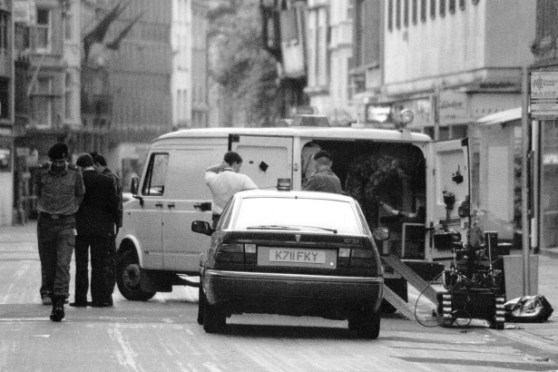
University gave me the occasional chance to dabble with press work.  I managed to be first on the scene with a camera when the Royal Engineers Bomb Disposal Squad were dealing with a series of incendiaries planted in shops on Cornmarket Street – usually the busiest shopping street in Oxford.

Oxford Bomb Squad (615)

I continue to love sports photography, whether for the school in which I work, or for a somewhat broader market.  I will never grow tired of being outdoors, particularly with a camera, and do enjoy the feedback from those who see my work.  Any monies are always welcomed!

Kiran (low res)

DCP (5) (615)

So to my Research Project… photographing stained glass windows in Oxford chapels.  Well, I wanted a challenge: it seemed too easy to stick with that which I had always done.

M3 Wk4: Show & tell

Week 4 Challenge: A Marketing Plan


Marketing can be challenging for photographers.  A marketing plan is basically a plan for the success of your business, and there are two main points to think about: your objectives and your strategy.

Create a marketing plan for your practice which covers the next 10 weeks.  Think about what you want to achieve with your photography during that time, and how you will make it happen.  Your plan should include your objectives and weekly actions.  Below are a few points you might want to think about.

Your objectives:

  • To raise your profile in the photography industry
  • To earn a certain amount of money from your photography
  • To develop your skills and knowledge
  • To arrange regular meetings with clients
  • To add a certain number of new contacts to your database each week
  • To increase hits on your website by a certain percentage

Your strategy: 
Think of this as a list of weekly actions, such as:

  • Editing your portfolio
  • Updating your website
  • Preparing a PDF portfolio presentation
  • Sending out a newsletter
  • Researching a new personal project
  • Spending 10 minutes a day on social media sharing posts on Instagram, Facebook and Twitter
  • Making three appointments to show your portfolio

Anna-Maria Pfab


I am somewhat separated from my work and have just found Internet connectivity for the first time in five days, while enjoying a heatwave in the South African late spring. While other distractions have occupied my mind, I have been considering this challenge.  It throws open numerous considerations, all of which are time-dependant.  I have commented previously that a very full-time job allows time either for photography or for coursework, but rarely both.  So it is that my photography takes the back seat for the time being while I address aspects of the coursework.

So far as marketing in the broad sense in concerned, I have various options that I am yet to investigate, but do not wish to rush into any of these just for the sake of a Module Challenge:

Getty Images: I have had an account, enabling me to contribute to Getty Images for some months, but have yet to put my mind to building my portfolio on the platform. Now seems an opportune time to start on this – while it is not necessarily my preferred ‘output’, it will enable my work to reach a huge potential market in a way that would be so very difficult through the more traditional digital platforms.  However, Getty Images would have file exclusivity, precluding any other usage.  Perhaps I must consider a separate set of images specifically for Getty Images?  However, there sister site iStock does allow non-exclusive licensing, enabling original work to be marketed through a third party as well.

Greetings cards: For many years I have had a finger in this market, through a distribution company.  Sadly the slow and gradual demise in this market has recently seen that company cease trading.  Notwithstanding, there remains a potential market to be tapped, but more for seasonal cards.  Stained glass window photography has revealed an area that could be exploited readily: many chapels include windows depicting scenes relating to the birth of Christ.  The production of a series of Christmas cards featuring a selection of those windows would seem a sensible forward step and could be distributed in a host of outlets within Oxford.  In addition to seasonal cards, a College may well be interested in marketing a selection of cards specific to their chapel.

Prints: mounted and/or framed prints – whether through a local gallery, directly through a college, or via a website.  For the past six years, my printing and framing needs have been met by an Oxford-based company that specialises in architectural styled images of Oxford and Cambridge Colleges.  It is set up to be able to print, mount, frame and ship, with my only involvement being signing and numbering of editions, and of particular interest to me: it already has a significant footprint within the Colleges of Oxford.  I have yet to discuss the promotion of my work on their site, but that must be a sensible next step for me.

When I return to Oxford, I will commit myself to the production and marketing of some stained glass window Christmas cards – just a small batch targeting a specific audience.

My website is ripe for overhauling, but again, this is not something I plan to do simply to tick a box – I need to spend sensible time planning and developing this area.

It has been an uphill battle arranging gallery meetings – my preferred location has a manager who is ‘very busy’, so I am inclined to look elsewhere.  Pleasingly there are various other locations within Oxford, with two right on the doorstep: the Sarah Wiseman Gallery and the North Wall Gallery?

A new personal project:  Within the school in which I work, I am routinely working on new projects and always have a long list of future projects.  Of course, these cover a host of different fields, but often have the central theme of ‘design’ in recent weeks, I have designed a new IT suite for the music department; designed and sourced new kit for our athletics team, and I am currently working on a redesign of the open spaces within our main classroom block.  On the photography front, sadly GDPR technicalities prevent me from publishing the majority of my projects beyond the confides of the school, as they relate to students within the school.  However, in the past two weeks, I have converted a tatty pin board covered corridor into a gallery featuring a large number of my framed images, ranging in size from A5 through to A2.  Foreshortening in the image below makes it look far more crowded than it is… although this location is deliberately far more crowded with images than would normally be the case in an exhibition space.  All of these projects are squeezed into the twilight zone between my full-time job, my coursework and the development of my research project.

Gallery lr

Part of the Wavell Building gallery.

Right now, I am traveling light in South Africa, not even with the delights of an iPhone X… instead relying upon the photographic capabilities of the iPhone 7 (as that is my South African mobile) and the Canon G3X.  While there is scarce opportunity for work that is even tenuously linked to my research project, each location I visit presents new and often beautiful opportunities…

IMG_0152 c lr

Sunset at Paternoster, Western Cape

IMG_2780 c lr

Strelitza (Bird of Paradise Flower)

M3 Wk4: Show & tell

Week 4: Independent Reflection


Begin at the Beginning…

Looking back over my early photography I am reminded of my passion for the outdoors and my love of rugged landscapes.  Life on the edge of Dartmoor could be harsh at the best of times and particularly so in the winter months.  I suspect it was the hard nature of the landscape that helped prompt me into the use of ‘hard’ printing techniques.    I have always been a somewhat insular person, happy with my own company and have a real preference for taking photographs devoid of people.  I still love being outdoors and my undergraduate years were spent reading Geology with routine trips to Devon, Cornwall and Scotland.  I remain inclined to photograph often stark landscapes… though no longer on 35mm and rarely edited in black and white.  I definitely miss spending time in the darkroom and have sadly sold all of my kit, but have an worryingly large collection of 35mm film cameras!

These days, more of my time is spent on ‘reportage’ photography, predominantly for the school. My own reaction to the different forms of photography I am involved in varies notably: while photographing landscapes, I find myself feeling at one with the location, working in harmony with the landscape, eager to depict the mystery, solitude or beauty of a location. By contrast, when photographing sports, drama or concerts, my work tends to be fuelled by adrenalin – I feel excited to be part of the action, always driven to capture ‘that moment’ that best summarises the event.


A Marketing Plan…

It has been quite a challenge to progress my marketing plan, trying to make contact with a host of companies who exist in the 9-to-5, Monday to Friday timescale, while I work 8-to-7 and beyond, six or seven days a week during term time.

I have deliberately not committed any time to my Getty Images account as this requires very considerable thought and involves significantly more permanent decisions than any of the other options.  Likewise, the production of postcards or greetings cards specific to individual colleges, or for marketing within the various tourist shops is an involved development that requires me to have discussions with the colleges, shop owners as well as publishers… definitely not a job for the small hours following an 11+ hour day!

However, progress has been made in other directions…

Prints: My hopes for promoting work on VA Prints website are somewhat in the balance: in a meeting with Ian Fraser, the photographer who runs the site, he advised that while the addition of my work would bolster his site and offer a harmonious counterpoint to his work, he has witnessed a decline in print sales since the Brexit referendum and is currently reviewing how much longer he will be running the site.  His print sales over Christmas this year will define the direction he takes in 2019 and beyond.  He and I will revisit this in the New Year.

Christmas Cards: working within a school that contains some of my favourite stained glass windows, including a series relating to the early years of Christ, provides a straightforward opportunity.  Because time is so very short between now and Christmas, and because the three windows in question are best illuminated by the sunlight in early summer, I opted to use some of my archive images, taken five years ago.

Commercially printed on the very finest 340gsm iPrint card, there are three designs of these large Christmas cards, two depicting the magnificent Henry Holiday stained glass windows in the Chapel of St. Nicholas and the third being a copy of the original vidimus hand-drawn drawn by Henry Holiday himself.

To ease distribution and simplify permissions, the sale of the cards is restricted to the staff within the school.  Thus far sales have been promising and response pleasing.

Website: careful consideration is needed in tackling the redevelopment of my website.  Currently it reflects my previous work for greetings card sales – interestingly in square format, years before Instagram normalised that format.  http://www.dpplimited.com

DPPLimited

I do not wish to consign these images to the bin, but they might form the basis of my Getty Images portfolio as my work transitions.

Gallery progress: I don’t doubt the frantic nature of managing an art gallery and while I have been extended an open offer to exhibit my work in the North Wall Gallery, for which I am most grateful, my preferred options lie elsewhere.

The Aidan Meller Gallery is my preferred location for an exhibition, but my communications with Mr Meller have achieved nothing more than the following response:

Many thanks for this. Send some attachments as a first step.  My time is very limited – sorry.  Aiden

Two brief and polite follow-ups enlisted no further response.  I hold courtesy and etiquette as fundamentals in business.  To that end I have made an initial contact with the Sarah Wiseman Gallery and await a response.

Within the school, the addition of my gallery has sparked considerable attention from those interested in improving the general décor and I have been asked to develop two further installations in Year Group-specific areas.