
Correcting years of damage
I remain ambivalent with regard to unnecessary alterations to the stained glass windows, although my intentions to create stand-alone art makes me inclined to correct cracks in glass, for example. However I wanted to see how effectively I could restore more demanding damage.
The East window of the Chapel of St. Nicholas dates back to 1896 and is the largest work by Henry Holiday in the chapel. Above the four lights is a roundel of Eunice and her son Timothy, which has sustained quite considerable weather-related damage over the past 120+ years, which is most obvious on the skin tones and in particular the two faces – why start with something simple?!


While this remains work in progress, I am particularly pleased with the results I have achieved on Eunice’s face.
There is still a long way to go with many of the individual pieces of stained glass. Both items of clothing above have had an initial tidy-up, but could be further improved – it is all just a matter of available time. With me heading off on a school trip to South Africa for the next two weeks, time is short!
The roundel is flanked by angels. Oddly, the angel on the left was in pristine condition whereas the other required extensive post production work on each skin-coloured piece of glass. Below is the semi-complete work:

UPDATE: August 01, 2018
Another 10+ hours of editing has produced a more complete restoration, although I am less than satisfied with the work. Some of the damage left minimal original material with which to work, making the reproduction of accurate textures very difficult.
The format of this blog better lends itself to a cropped view of the roundel of Eunice and Timothy, so below is a before and after animated GIF:

Eunice and Timothy (Henry Holiday, 1896) Chapel of St. Nicholas




 To the top right of the artwork is some almost invisible and hard to decipher text, partially obscured by cobwebs. Part of this text appears to be mirrored (although having flipped the image, it is no more clear). I have done my best to clarify the text in the image below, depicted as viewed from within the chapel, but it remains far from clear. I will need a second visit to the college chapel in order to better capture this fine detail and given time, will investigate further.
 Maxfield Parrish (1902) – Its Walls were as of Jasper
 A visit to the Baylie chapel, to the left of the chancel, within The Chapel of John the Baptist, St. John’s College, reveals a window with three main lights each depicting the coat of arms of significant figures from St. John’s history.


 It should be noted that the photographs were originally taken on a bright, overcast day in late March, when the daylight colour temperature was less warm than today, as was the intensity of the light (with today being partially cloudy). However, since I had undersaturated some areas and oversaturated others, it was clear that the changes were not just as a result of weather or seasonal conditions. The changes see an increase in the saturation of the helmet, together with a recolouring towards orange/gold; The wooden staff and hands have been desaturated; and finally, the red background drape has had a increase in saturation as well as a recolouring towards ‘pure red’ – I am not convinced that I have yet made sufficient changes to the colour of the drape.
 Courage – BJ 397 (Edward-Burne Jones, 1896) The Chapel of Harris Manchester College


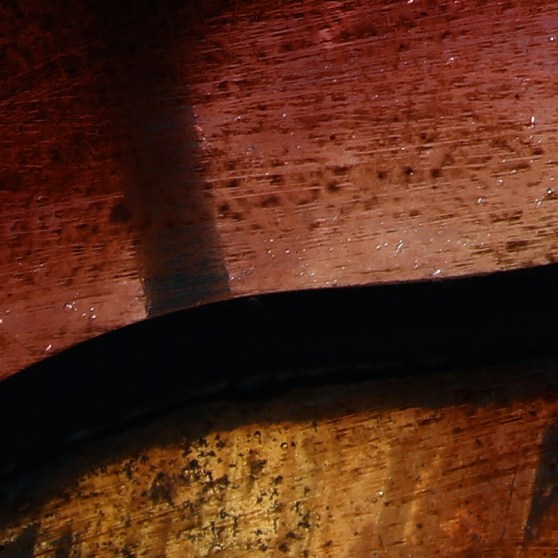


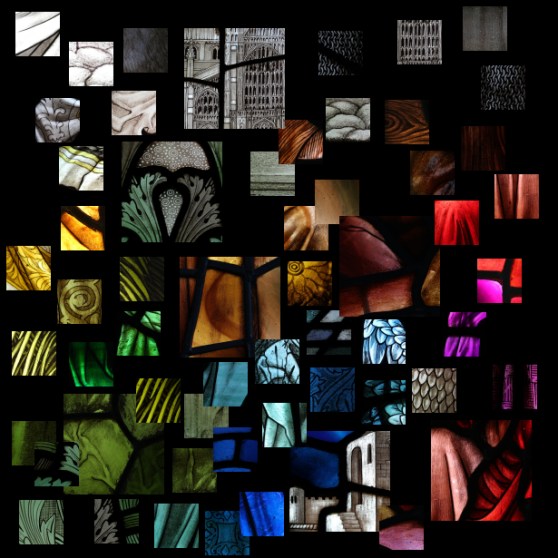

 I have just revisited The Chapel of John the Baptist at St. John’s College in order to understand better the text scratched into the glass at the top right of the right hand
  The two