Project Development

Mansfield College Chapel – Planning visit


Today was due to be a reconnaissance visit to Mansfield College Chapel, but as I was travelling to the neighbouring Harris Manchester College to photograph the east window, despite the less than ideal lighting conditions (bright, clear blue sky) it seemed sensible to attempt some photography.

IMG_3543 ce (lr)

The Victorian Gothic chapel is one of the largest in Oxford and is now a multi-function space.  The college chapel is unconsecrated, and contains stained glass windows and statues depicting leading figures from Nonconformist movements, including Cromwell, Sir Henry Vane and William Penn.  Chapel services are still conducted in a Nonconformist tradition, with an evening service each Wednesday.  It is routinely used as a dining hall – indeed on my visit I was being set up for a significant banquet.

The chapel is aligned almost north-south and with harsh sunlight pouring through the west windows, precluded them from being photographed.  However, the light was more sympathetic on the east wall, where there were a number of low-level windows, sadly, most of these were partially obscured by internal fittings and furnishings stacked within the chapel in addition to receiving unbalanced lighting thanks to foliage outside.

IMG_3536 (lr)

The south windows, while very high,  benefitted from having the full length of the chapel to help minimise angles and converging verticals.  Additionally, the pews at the north end (shown above) afforded some additional height.

While I do have the appropriate kit with me, I imagine that a follow-up visit may be sensible on a day with more sympathetic lighting.

Project Development

New College Chapel – Planning visit


In my mind, my intention in New College Chapel was to photograph the Great West window from the organ loft.  However, the brilliant afternoon sunshine was streaming through the west end making such work impractical, so I opted to soak up the atmosphere while the choir was rehearsing.  My short video, recorded from the south side, does provide an idea of the enormity and expanse of the stained glass within the chapel, initially showing a glimpse of some of the ante-chapel glass, before sweeping across the five windows of the north side, with each window containing eight main lights.  The south side is similarly glazed.

© The Choir of New College (Ave verum corpus by William Byrd)

New College Chapel dates back to the fourteenth century and is one of the main choral foundations of the University of Oxford, with a choir regarded as one of the leading choirs of the world, and has recorded over one hundred albums.  It hosts some stunning stained glass that spans the centuries, with windows designed by the 18th-century portraitist Sir Joshua Reynolds and contains works by Sir Jacob Epstein and El Greco.

On this visit, I was seemingly not fully focussed on the task in hand, as despite having the keys to all areas of the chapel, I failed to make observations from the organ loft and also failed to register the windows of the ante-chapel which are recently restored medieval stained glass.  In a restored state, they may be a fine choice if the lay of their surrounds proves favourable.

IMG_3566 (low res)From within the body of the chapel, it is difficult to photograph the lights as a result of their great height, so I am heavily reliant upon the organ loft providing an appropriate view of the glass at the west end, which would be best photographed in the early morning light.

I did make a point of pausing in the cloisters to capture an image – not that it is of any direct value to my Research Project. Clearly I do need another planning visit.

Project Development

Harris Manchester College Chapel – revisited


My initial visit to The Chapel of Harris Manchester College saw the East Window shrouded in protective covers while cleaning work was taking place outside.  The chapel is not typically oriented, so the east window, in this instance, is located at the rear of the chapel.

Harris Manchester is undoubtedly the most welcoming college – I am always greeted like a long-lost friend by the Porter’s Lodge, and have been accommodated without any problem, allowed to get on with my work in the most beautiful surroundings.

While I endeavour to restrict myself to just a single stained-glass window (or light) from each chapel, I keep finding myself drawn back to this chapel, which is filled with stunning work by William Morris and Edward Burne-Jones.

The east window was undoubtedly worth my revisit… it is impressively large, and stunning!  Sadly, and in keeping with many chapels and churches, the five main lights are all backed by protective mesh, which although subtle and almost unnoticeable to the casual observer, creates an obvious and detracting element to any photograph, even when reduced to a thumbnail…

DCP_8660 (quick edit) (low res)

The quick edit of the entire east window, above, provides just a hint of the stunning colours and design.  However, for the development of this project, I focussed most of my efforts on the top third of the window, lavishly illustrated with angels and devoid of protective mesh.

East Rose - PNG (low res).png

Teaching the Ignorant (BJ237 Edward Burne-Jones, 1896) The Chapel of Harris Manchester College

It is always a pleasure, when working on roses, not to have to remove support bars!  As a result, the editing time was quick by comparison. The image was shot at 349mm, using the Canon EF 100-400mm f/4.5-5.6L IS II USM lens, at an aperture of f/8.0 and exposure times ranging from 1/30 s to 1/2 s.  However, I am unsure whether this image is best presented square or circular.  I committed to a square print of the west window, but rather like the appearance of this one cropped as a circle…

East Rose - cut out PNG (low res)

M3 Wk1: From here to there

Week 1 Challenge: Time to Play


This week’s activity is from Michael Christopher Brown, an American photographer represented by Magnum Photos. He has gained an international reputation, especially for his documentation of the 2011 Libyan Civil War, which was published in a monograph titled Libyan Sugar, by Twin Palms Publishers in 2016.

“For much of my career, photography was more of a way to make money than a compulsion. I spent a lot of time communicating ideas that were not my own. Two years ago, during the Libyan Revolution, I began taking a more honest path with regards to photography. It had to do with finding a voice. An interesting exercise that anyone can do is to take one photograph per day for a week. The idea is to be focused enough to only photograph what is absolutely necessary. What are the seven pictures that not only define the week, but yourself? What if you were to die next week and these were to be the last seven pictures of your life? This exercise can be an important analysis of the self in relation to life and photography.”

Task
Post your seven pictures in the forum space below and discuss what you have discovered.


Week 1 in photographs, captured on an iPhone X…

CE IMG_3522 (low res)Sunday: Choir practice prior to evensong at the Chapel of St. Nicholas.  In 20 years of singing in the chapel, I have never seen the east windows looking so impressively lit.  17:46, four minutes before the start of the practice and the sun was low in the sky to the west, with beautiful clear blue sky lining up perfectly with the top section of the window and sunlight reflecting off the autumnal hues of the trees some 120m in the background, providing warmth to the four figures.  I must hope for repeat conditions when I have the opportunity to photograph the window properly!

CE IMG_3525 (low res)
Monday: After 12 hours of uninterrupted meetings and contact time with children, the evening presented the chance for some project work.

CE IMG_3526 (low res)Tuesday: A full day of duties. 16:45 was my first break in the day, with duties continuing until 20:25.  As the final few boys head out for football practice, I had the chance to sit on the steps and appreciate a beautiful day in Oxford.

CE IMG_3531 (low res)Wednesday: My half day… I am free from 11:30, so headed out to the other side of Oxford to collect a selection of double-mounted prints that I am gradually putting together in readiness for a exhibition.  With the prospect of 40+ images to have mounted and framed, I am having to do this a few at a time to spread the cost. I am yet to commit to the framing!

CE IMG_3536 (low res)Thursday: Short Leave… the first break of the Michaelmas term and the chance to add to my portfolio.  Mansfield College is a stunning location, lit rather too well today, but that aided in my selection of stained glass windows to photograph.  The weather was just brilliant, and it is the perfect time to visit Oxford: most tourists and school visits have ceased, and the students do not return until Monday.  The back streets were quiet and I was quickly reminded why I love living here – I had a smile on my face all afternoon.

CE IMG_3551 (low res)Friday: More time spent in town and another perfect day… sadly not so perfect for photographing stained glass, where the idyllic conditions are overcast but bright.  New College is an old haunt at which I have sung on many occasions.  On checking in with the Porter’s Lodge, I was simply handed the huge and impressive bunch of ancient keys to the chapel (why didn’t I photograph them?!), and told to help myself.  However, the cloisters were looking particularly fine (known to many who have enjoyed the Harry Potter films).

CE IMG_3563 (low res)Saturday: Another beautiful day with the opportunity to edit some of the photographs taken in the past two days.  Extraordinarily, for the final days of September, my garden still needs watering and this is the rather splendid sight on the wall at the end of the garden: a vine growing from cuttings taken from an ancient vine within the school.

M3 Wk1: From here to there

Week 1: Reflection


Module 2 presented a number of difficulties for me largely as a result of the heavy work load and extracurricular commitments that surround the summer months.  My hope for Module 3 is that I will have the time to tackle the weekly assignments, webinars and course trappings on time – not least because I do not have the advantage of any holiday period in which to play catch-up.  Sadly, a newly introduced, restructured working day seems to overlook the need for any breaks in the day.  This would not be a significant problem if weekends were time off, but unfortunately in boarding education, the weekends are normal working days.

‘Alarmed’ does not come close to describing my feelings when I realised that the entirety of this university term and all the various deadlines, fall within the Michaelmas academic term of the school in which I teach.  Looking towards the end of the course and term, while writing 240+ end of term reports in the slack time around teaching, supervising and planning (a task clearly designed to test ones ability to work unhindered through prolonged sleep deprivation), I will also be fretting about the Oral Presentation – something that has thus far occupied me for more than a week of holiday each time I have produced one.  More worryingly, it looks as though the Sustainable Prospects course does not even allow a slight pause to accommodate assignments!

However, it is Monday of week 1, and I am in the process of completing much of the weekly expectations… just a day or two late.

I have enjoyed the opportunity this week to visit three of Oxford’s chapels, housed within New College; Mansfield College and Harris Manchester College.  This has provided me with many tens of hours worth of editing – in fact well over 150 hours worth, if I edit all of the stained glass windows that I have photographed.  The time it takes to produce just one edited image is a source for concern.  I do invest heavily into selecting, where possible, windows that require less complicated editing, and that editing is becoming ever more efficient, but one completed stained glass window still represents 20+ hours of editing.  Clearly time-management is of vital importance, but difficult to achieve when salaried work commitments in term time weigh in at around 60 hours per week.

Week 1 has been an interesting journey through the ideas of photographic employment.  I have no doubt that many will have listened to and read about the wealth of varied jobs that fall into the umbrella of photography, and realised that they currently do most of them unaided!  I have been described as a ‘control freak’ and a ‘perfectionist’ by those who routinely experience my photographic, reprographic and design work: I struggle to step away from any aspect of a project.  Clearly if I am to move into full time photography, it seems clear that I have to accept that I will only be one part of a process.  Perhaps it is time to rationalise what I currently do… difficult… I love the freedom of composition and image capturing; I enjoy the ‘chase’ of image editing and the satisfaction of a completed image; I quietly enjoy the appreciation by others of my work, and just occasionally I have the gratification of payment!


Time to Play:

Retrospectively, I thoroughly enjoyed the challenge of taking a photograph each day.  There were a couple days when I rather forgot, but the results seem fine and the annotations resulted in a narrative that painted a rough picture of my working life.


Looking Back:

I suspect that there is little by way of reflection that I can add to the a piece that is in itself a reflection, although I am rather sorry and surprised that a piece of work from the ‘break’ cannot be included in the Module 3 Work in Progress Portfolio.

Broken mirrors

Sunset Reflections


Always lurking in the back of my mind are thoughts as to how best to exhibit my work.  From time to time, my research reveals portfolios not too dissimilar, with the following being of particular interest:c

A simple concept (so often the way with great ideas) by New York-based photographer Bing Wright: he used shattered mirrors to catch the reflections of the setting sun and experimented with different types of film to enhance further the images.  The reflections have more than a passing likeness to stained glass windows.

In his exhibition at the Paula Cooper Gallery in New York, the images were printed almost 2m tall – something I am keen to consider when it comes to exhibiting my work, although I am rather fearful at the potential costs.

Mirror 04

Bing Wright (2012) Broken Mirror/Evening Sky (Kodak Provia), New York

Mirror 02

Bing Wright (2012) Broken Mirror/Evening Sky (Cibachrome), New York

Mirro 01

Bing Wright (2012) Broken Mirror/Evening Sky (Agfacolor), New York

Mirror 03

Bing Wright (2012) Broken Mirror/Evening Sky (Kodacolor), New York

Knowing that banner prints are significantly more affordable than framed art prints, it may well prove sensible to promote my proposed exhibition using 2m high banners.

Wright’s 2017 portfolio Cherry Tree Grids demonstrates a striking resemblance, from a distance, to some of my interpretations of stained glass windows from Module 2:

Cherry_Tree_Grid_Large_001

Bing Wright (2017) Large Cherry Tree Grid 001, New York

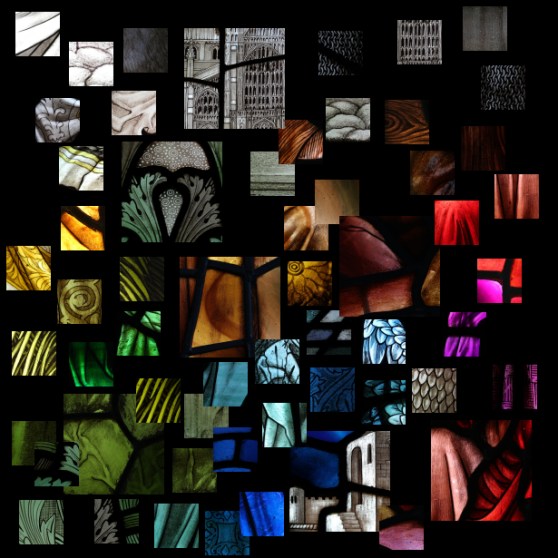
NEW Composition (low res)

Dominic Price (2018) Abstract Tiles, Oxford

M3 Wk2: You are a business

Week 2: Whose Image is it Anyway?


2_02_Forum.png

Image on left: original photography by Patrick Cariou / image on right: artwork by Richard Prince

Copyright law.  There have been some notable art copyright cases in recent decades. One of the most significant is French photographer Patrick Cariou’s claim, suing Richard Prince and his gallery, Gagosian, for copyright infringement. Read more about the case here  or an even more detailed report here.


I am no fan of this style of work – how can a few crude daubs of paint and a magazine cutting make this a new work of art (or indeed ‘art’). There seems far too much sympathy in using the work ‘appropriation’ – there is no synonym that can make it acceptable. If it necessary to exhibit such work, I could come close to tolerating it if there were clear apologies to the original artist/photographer and if the exhibition was clearly labelled as being one of intellectual property theft and vandalism.

I cannot begin to agree with the decision of the court.

I find it saddening that one level of argument in favour of the court is that Cariou did at least gain publicity for his work. When Cariou took the original photography, he had no intention of gaining from the exposure of this case. It must be rather galling to be better known as the person whose work was appropriated by someone else, rather than for your skills as a photographer.

Cariou was not approached with regard to permission, so it would seem improbable that the subject in the photograph received that common courtesy. I wonder how such a case would be handled in Europe? The GDPR issues alone could be sizable.

In the back of my mind is the thought that my project could be seen as being repurposing of other people’s art: the project sees me photographing then editing stained glass windows. However, the artists are all deceased, I always seek permission from the owner of the art work prior to any photography, and I gain approval for use of the photograph once the editing is complete. My project does not see me reinterpret the works (despite Course-based encouragement to do so) and the only editing is corrective (removing cracks in glass; erasing grime and dirt; removing support bars). Any publication of the images sees full reference to the original artist, the copyright owner of the original item and details the location of the item: I am working in collaboration with the owners (in the absence of the artist). I believe that this is the only acceptable way of ‘using’ pre-existing art works… however, for the benefit of my project, should you feel that I am omitting an important step, please do comment to that effect.

M3 Wk2: You are a business

Week 2 Challenge: Let’s Talk Business


This week’s activity therefore, requires thought about the following three areas in relation to my practice:

  • A Mission Statement
  • The Product
  • The Market

This is an opportunity to consider them from a more commercial angle.


Mission Statement
The fantastic beauty of stained glass windows is rarely replicated in a photography as there are so many factors inhibiting the process: the weather and lighting conditions may be unfavourable; a camera lacks sufficient dynamic range; there may be a build-up of years of dust and grime; the horizontal support bars detract from the original design.  Dominic Price’s vision is to record an image that is a lasting memory of a stained glass window, viewed as fresh and clear as the original artist would have wanted.

The Product
An initial site visit ascertains the logistics of the shoot, together with the most opportune time of day and time of the year to take the photograph.  Diffused, bright light is optimal, avoiding harsh shadows created by the lead calmes that hold the individual panes of glass together.  However, vegetation and surrounding buildings can have a dramatic impact on the anticipated lighting were one to carry out remote calculations.  If the site lends itself to a straightforward set up, then the photography stage typically takes no more than an hour per light (an individual vertical division of a window), with up to 30 exposure bracketed images being taken for each view.  The stained glass window or light is then reconstructed individual pane at a time, by selecting the most appropriately exposed fragment of an image from the exposure bracketed range.  With the image reassembled, any damaged or overly dirty panes are corrected.  A follow-up location visit allows the chance for a final comparison with the original prior to the digital removal of any support bars.  The final image can be supplied in a number of ways, from digital file to a host of print options, with a Giclée print on 310gsm standard fine art paper; double mounted in white card, then black box framed, being the preferred finish.

The Market
With scarce competition in the field, the potential market is huge: any location with stained glass.  Beyond individual images, there is the opportunity for exhibiting works to local communities as well as publishing the images within guide books or as greetings cards.  Clearly religious festivals are well documented within stained glass windows and lend themselves well to the greetings card market.

M3 Wk2: You are a business

Week 2: Independent Reflection


This has been a week where necessity had placed project-related practical work on hold.  However, I have sourced some useful publications to which I have committed time in the evenings…

Waters, W. (2012) Angels & Icons Pre-Raphaelite Stained Glass 1850-1870. Worcester: Seraphim Press Ltd. (Photography: Carew-Cox, A.)

Angels & Icons.jpgThis stunning 368-page hardback came direct from the photographer and represents nine years of research by author William Walters.  The detail is impressive and it has already proved its worth in helping with my research.  Possibly more importantly and certainly more uniquely within this field, it is illustrated throughout with exquisite images taken by photographer Alastair Carew-Cox.

I have been in communication with Alastair a few times with regard to his work.   For Angels & Icons he used 5″x4″ film and a plate camera to correct perspective.  However, in his most recent publication Damozels & Deities, in addition to plate he has used high end digital with tilt and shift lenses.  Because of the academic importance of the publications, he has to photograph what is actually in front of him, warts and all.  Consequently, unlike my images, his receive minimal post production, with the support bars, blemished and damage, etc., left in.

Volume three of the series is currently being researched and photographed, featuring far more of the works of Henry Holiday – a favourite artist of both of us.


Lifelines 12With a number of my recent site visits featuring the works of Edward Burne-Jones, another book purchase was also by William Walters:

Waters, W. (1973) Burne-Jones: An Illustrated Life of Sir Edward Burne-Jones 1833-1898. Aylesbury, Shire Publications Ltd.

One of the earlier publications by Walters, this 48-page small paperback is illustrated throughout in black and white.  It provides an interesting life story of Burne-Jones, but sadly (for me) only touches on his stained glass work, focusing instead more on his watercolours and pencil drawings.


Rather less of an easy read and substantially harder to source, was one of Henry Holiday’s books:

Holiday, H. (1914) Reminiscences of My Life. London, William Heinemann.

I was hoping that this autobiography would mention some of Holiday’s works for the Chapel of St. Nicholas, but sadly there is no reference at all!  I outlines the varied and numerous interests of the artist and in particular his involvement with the Pre-Raphaelites,  and is illustrated with his work.  Thus far I have only dipped into the pages, having prioritised work, research and sleep ahead of the 465 pages!

Project Development

University College Chapel – Planning visit


Work started on Univ Chapel in 1639.  Inspired by the Dutch artist Abraham van Linge‘s windows in the chapels of Lincoln College and Queen’s College, together with Christ Church Cathedral, eight side windows and one grand east window was commissioned.

While the side windows were finished in 1641 (van Linge’s last windows in Oxford), the English Civil War interrupted further work and it was not until after the Restoration of the Monarchy that the chapel was consecrated (20 March 1666).

The east end of the chapel was captured in a photograph by William Fox Talbot shortly before an extensive refurbishment in the 1860’s that saw the installation of a new roof and east window.  More images can be seen in The Talbot Catalogue Raisonné.

University College Chapel - Fox Talbot.jpg

William Fox Talbot (1843) University College Chapel

Unfortunately, without further permission to access the Master’s Lawn, I am unable to recreate this image perfectly, which would have been a fitting touch.  However, my image below shows the significant alterations that were made to the chapel following Fox Talbot’s photograph.  That gives me an idea for another project: In the footsteps of Fox Talbot, recreating his Oxford portfolio.  Perhaps in another life.

Univ Chapel (low res).jpg

Van Linge (lr)Permission to photograph the chapel was  a long time coming, but I was granted permission for a planning visit on 10 October, spending some time appreciating the location and considering the options.  It is probable that in keeping with my recent work in Harris Manchester, I will capture some of the smaller lights within the east window in addition to one or two larger lights.  The perennial challenge of excluding large candelabras from the photographs will be a feature here, with two at a frustratingly low-level.

Univ (lr)