M3 Wk3: The digital new possibilities

Week 3: Instagram


I would argue Instagram is currently the most effective social media platform for self promotion.  If you have not got an Instagram account already, then I would like you to set one up.

This week I want you to try and create and implement an Instagram strategy that you feel will help you reach future, potential clients (whether ad agencies, curators or potential collectors), and then develop your account so you have 30 followers over the course of a week.

Anna-Maria Pfab


As a long-term user of Instagram, the technical difficulties of setting up a ‘business’ account were minimal.  However, the process did flag up concerns about the safety of my works online.

To maximise the visual impact of posted images, I followed the recommended resolution: 1080px x 1080px.  In order to present some of my images uncropped, I have spread them across three posts… producing a 3.2mp image that could be grabbed and used in certain circumstances on a commercial basis.

In keeping with many social media sites, Instagram demonstrates very little care for its users and forces a licencing agreement (HERE) upon users that is at best questionable, and led to much discussion within the Falmouth Forum.

InstagramI was certainly neither keen nor enthusiastic to be ‘forced’ to jump into such a project without being given the appropriate time for planning as well as researching best practice.  However, when compared with the Week 3 Challenge, there were far fewer consequences to the potential for getting this wrong, so with much tentative care I progressed.

My initial account was set at ‘Private’, but after three days I changed that setting, realising that it was impractical to have a private business account!


M3 Wk3: The digital new possibilities

Week 3: Challenge – Image Virus


This week you will create an Image Virus.

Make an image that you feel is intriguing and appealing, and spread it around as many places as possible. Keep the credit anonymous. Photocopy the image and paste the copies on walls throughout your city (within reason – I don’t want you to get into trouble for fly posting), mail copies to everyone you know, post copies through letter boxes in your neighbourhood. On the back of the photocopy leave only an e-mail address and a hasthag. If anyone e-mails you, reply with only the image as an attachment. E-mail this image to everyone you know. Make a website for it, make it your status on social media – tweet it, post it, blog it. And get others to spread it around the internet; ask you friends to help. If the virus becomes widespread enough, you might find it returned to you, or used by others.
I obviously don’t want to get you into trouble – so please do this within reason.

The internet is a powerful space and will present you with many possibilities to spread your Image Virus. Track your Image Virus via any e-mails you receive, and with the hashtag. Do this for a few days, or even a few weeks, and then write 200 – 300 words on what happened and share your experience with your peers in the space below. Discuss what worked, and what did not work.

If you need a little inspiration – I once did something similar when I was studying and the results were as fascinating as astonishing.

Here is an overview of that project: http://spaceyideas.com/todonnalovebob/

Anna-Maria Pfab


I have thought long and hard about this challenge.  Working primarily in IT, my contact list, built up over 25+ years, has a significant bias toward those in the broad field of IT.  Junk mailing them with an image and the tag Image Virus is likely to achieve little more than to test their firewall.  I have tested this premis on our servers, within a walled garden (essentially a secure virtual environment designed for testing web-based matters). Our security blocked the message from being sent… even if ‘virus’ was not in the subject.

Moving away from the IT side of things, I question the positive influence of junk mailing potential clients or flyposting their neighbourhood.  Oxford City Council has fought against this proactively for many years (New powers used to tackle blight of flyposting) with fines of up to £2500 in addition to on-the-spot-fines.

For me to participate in this challenge, a rethink is required. When time allows, I will endeavour to turn to a more research-based ‘virus’.  Many years ago I was given a Kodak Junior No.1A, complete with 100’s of negatives.  A recent house move revealed them once again and I had the inclination and a little time to look further, revealing a fascinating story of life in India or perhaps Egypt in the early 1900’s.  I would love to know more, so perhaps using the Internet to spread these images may help.

The best I have achieved thus far is that the vehicles are Holt Tractors which were introduced to the army in 1913.

Kodack Junior 01Kodack Junior 02Kodack Junior 03

M3 Wk3: The digital new possibilities

Week 3: Independent Reflection


Instagram:

The account has taken shape quite well: dpplimited, but it strikes me as odd that there is no option to ‘invite’ followers within Instagram.

With hindsight, creating the account and adding 27 images prior to any tagging or attempts to attract custom may have been an error.  A drip-feed of those images would have made better sense.  I am also regretting the choice of a layout that requires posts three-at-a-time to be added – this makes the process of posting far more involved and not always as instant as I would like, since I have to wait until I have three appropriate images to add.    However, by the end of the week the account was being followed by at least 30 people.

I question the usefulness of Instagram as a business tool for my photography… Instagram predominates on mobile platforms, with images being viewed small-scale.  With only 10% of Instagram users being over 35, it seems probable that the vast majority on Instagram would be disinterested in stained glass windows.


Image Virus:

I have not yet ventured into the image virus foray, but stand by the variation of investigating I mooted, using the power of the World Wild Web to help the Kodak Junior No.1A images.

M3 Wk4: Show & tell

Week 4: Begin at the Beginning


Today I want you to rediscover why you love to take photographs.

Review your earliest work an reflect: What do you see in it? Can you find a theme that connects it to the work you make today? What do you like and dislike about the early work? What was it about these photographs that made you want to be a photographer?

Use the space below to share and discuss these photographs with your classmates. Comment on the work of your peers – especially if you are familiar with the kind of work they are doing now. Tell them what you see in their early work and how it connects to what they do now.

Anna-Maria Pfab


I was taking photographs from the age of about 8 and with access to a darkroom, it was not long before I was printing my own work. As a youngster I used to love my time in the darkroom. There was definitely a sense of magic in watching the images develop: it seemed to be a very special place, working under filtered light in a small space with and a smell of chemicals that I have always liked! What can I say… I have a BSc and was formally Head of Science at a school – the enjoyment of chemicals has never left me!

Sadly I cannot locate any of my images from those early days, but by the time I was 17 I was teaching myself A-Level photography, with a portfolio based on the local landscape: living on the edge of Dartmoor I was rather spoilt for choice and loved being outside taking photographs.  I developed a penchant for printing images very hard on Ilford Multigrade…


I also spent much time photographing the sports and events around the school, with running costs being covered by the school (they would get to use my images for the school magazine) and prints also being sold to my friends. While I loved photography, and enjoyed providing a much appreciated service for my friends, I was also enjoying making money out of the process – a very important thing for a teenager!

School Photo queue (615)

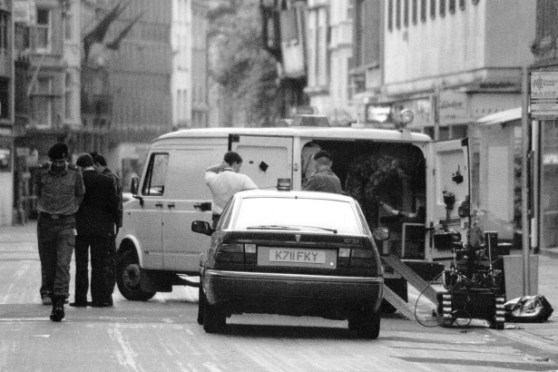
University gave me the occasional chance to dabble with press work.  I managed to be first on the scene with a camera when the Royal Engineers Bomb Disposal Squad were dealing with a series of incendiaries planted in shops on Cornmarket Street – usually the busiest shopping street in Oxford.

Oxford Bomb Squad (615)

I continue to love sports photography, whether for the school in which I work, or for a somewhat broader market.  I will never grow tired of being outdoors, particularly with a camera, and do enjoy the feedback from those who see my work.  Any monies are always welcomed!

Kiran (low res)

DCP (5) (615)

So to my Research Project… photographing stained glass windows in Oxford chapels.  Well, I wanted a challenge: it seemed too easy to stick with that which I had always done.

M3 Wk4: Show & tell

Week 4 Challenge: A Marketing Plan


Marketing can be challenging for photographers.  A marketing plan is basically a plan for the success of your business, and there are two main points to think about: your objectives and your strategy.

Create a marketing plan for your practice which covers the next 10 weeks.  Think about what you want to achieve with your photography during that time, and how you will make it happen.  Your plan should include your objectives and weekly actions.  Below are a few points you might want to think about.

Your objectives:

  • To raise your profile in the photography industry
  • To earn a certain amount of money from your photography
  • To develop your skills and knowledge
  • To arrange regular meetings with clients
  • To add a certain number of new contacts to your database each week
  • To increase hits on your website by a certain percentage

Your strategy: 
Think of this as a list of weekly actions, such as:

  • Editing your portfolio
  • Updating your website
  • Preparing a PDF portfolio presentation
  • Sending out a newsletter
  • Researching a new personal project
  • Spending 10 minutes a day on social media sharing posts on Instagram, Facebook and Twitter
  • Making three appointments to show your portfolio

Anna-Maria Pfab


I am somewhat separated from my work and have just found Internet connectivity for the first time in five days, while enjoying a heatwave in the South African late spring. While other distractions have occupied my mind, I have been considering this challenge.  It throws open numerous considerations, all of which are time-dependant.  I have commented previously that a very full-time job allows time either for photography or for coursework, but rarely both.  So it is that my photography takes the back seat for the time being while I address aspects of the coursework.

So far as marketing in the broad sense in concerned, I have various options that I am yet to investigate, but do not wish to rush into any of these just for the sake of a Module Challenge:

Getty Images: I have had an account, enabling me to contribute to Getty Images for some months, but have yet to put my mind to building my portfolio on the platform. Now seems an opportune time to start on this – while it is not necessarily my preferred ‘output’, it will enable my work to reach a huge potential market in a way that would be so very difficult through the more traditional digital platforms.  However, Getty Images would have file exclusivity, precluding any other usage.  Perhaps I must consider a separate set of images specifically for Getty Images?  However, there sister site iStock does allow non-exclusive licensing, enabling original work to be marketed through a third party as well.

Greetings cards: For many years I have had a finger in this market, through a distribution company.  Sadly the slow and gradual demise in this market has recently seen that company cease trading.  Notwithstanding, there remains a potential market to be tapped, but more for seasonal cards.  Stained glass window photography has revealed an area that could be exploited readily: many chapels include windows depicting scenes relating to the birth of Christ.  The production of a series of Christmas cards featuring a selection of those windows would seem a sensible forward step and could be distributed in a host of outlets within Oxford.  In addition to seasonal cards, a College may well be interested in marketing a selection of cards specific to their chapel.

Prints: mounted and/or framed prints – whether through a local gallery, directly through a college, or via a website.  For the past six years, my printing and framing needs have been met by an Oxford-based company that specialises in architectural styled images of Oxford and Cambridge Colleges.  It is set up to be able to print, mount, frame and ship, with my only involvement being signing and numbering of editions, and of particular interest to me: it already has a significant footprint within the Colleges of Oxford.  I have yet to discuss the promotion of my work on their site, but that must be a sensible next step for me.

When I return to Oxford, I will commit myself to the production and marketing of some stained glass window Christmas cards – just a small batch targeting a specific audience.

My website is ripe for overhauling, but again, this is not something I plan to do simply to tick a box – I need to spend sensible time planning and developing this area.

It has been an uphill battle arranging gallery meetings – my preferred location has a manager who is ‘very busy’, so I am inclined to look elsewhere.  Pleasingly there are various other locations within Oxford, with two right on the doorstep: the Sarah Wiseman Gallery and the North Wall Gallery?

A new personal project:  Within the school in which I work, I am routinely working on new projects and always have a long list of future projects.  Of course, these cover a host of different fields, but often have the central theme of ‘design’ in recent weeks, I have designed a new IT suite for the music department; designed and sourced new kit for our athletics team, and I am currently working on a redesign of the open spaces within our main classroom block.  On the photography front, sadly GDPR technicalities prevent me from publishing the majority of my projects beyond the confides of the school, as they relate to students within the school.  However, in the past two weeks, I have converted a tatty pin board covered corridor into a gallery featuring a large number of my framed images, ranging in size from A5 through to A2.  Foreshortening in the image below makes it look far more crowded than it is… although this location is deliberately far more crowded with images than would normally be the case in an exhibition space.  All of these projects are squeezed into the twilight zone between my full-time job, my coursework and the development of my research project.

Gallery lr

Part of the Wavell Building gallery.

Right now, I am traveling light in South Africa, not even with the delights of an iPhone X… instead relying upon the photographic capabilities of the iPhone 7 (as that is my South African mobile) and the Canon G3X.  While there is scarce opportunity for work that is even tenuously linked to my research project, each location I visit presents new and often beautiful opportunities…

IMG_0152 c lr

Sunset at Paternoster, Western Cape

IMG_2780 c lr

Strelitza (Bird of Paradise Flower)

M3 Wk4: Show & tell

Week 4: Independent Reflection


Begin at the Beginning…

Looking back over my early photography I am reminded of my passion for the outdoors and my love of rugged landscapes.  Life on the edge of Dartmoor could be harsh at the best of times and particularly so in the winter months.  I suspect it was the hard nature of the landscape that helped prompt me into the use of ‘hard’ printing techniques.    I have always been a somewhat insular person, happy with my own company and have a real preference for taking photographs devoid of people.  I still love being outdoors and my undergraduate years were spent reading Geology with routine trips to Devon, Cornwall and Scotland.  I remain inclined to photograph often stark landscapes… though no longer on 35mm and rarely edited in black and white.  I definitely miss spending time in the darkroom and have sadly sold all of my kit, but have an worryingly large collection of 35mm film cameras!

These days, more of my time is spent on ‘reportage’ photography, predominantly for the school. My own reaction to the different forms of photography I am involved in varies notably: while photographing landscapes, I find myself feeling at one with the location, working in harmony with the landscape, eager to depict the mystery, solitude or beauty of a location. By contrast, when photographing sports, drama or concerts, my work tends to be fuelled by adrenalin – I feel excited to be part of the action, always driven to capture ‘that moment’ that best summarises the event.


A Marketing Plan…

It has been quite a challenge to progress my marketing plan, trying to make contact with a host of companies who exist in the 9-to-5, Monday to Friday timescale, while I work 8-to-7 and beyond, six or seven days a week during term time.

I have deliberately not committed any time to my Getty Images account as this requires very considerable thought and involves significantly more permanent decisions than any of the other options.  Likewise, the production of postcards or greetings cards specific to individual colleges, or for marketing within the various tourist shops is an involved development that requires me to have discussions with the colleges, shop owners as well as publishers… definitely not a job for the small hours following an 11+ hour day!

However, progress has been made in other directions…

Prints: My hopes for promoting work on VA Prints website are somewhat in the balance: in a meeting with Ian Fraser, the photographer who runs the site, he advised that while the addition of my work would bolster his site and offer a harmonious counterpoint to his work, he has witnessed a decline in print sales since the Brexit referendum and is currently reviewing how much longer he will be running the site.  His print sales over Christmas this year will define the direction he takes in 2019 and beyond.  He and I will revisit this in the New Year.

Christmas Cards: working within a school that contains some of my favourite stained glass windows, including a series relating to the early years of Christ, provides a straightforward opportunity.  Because time is so very short between now and Christmas, and because the three windows in question are best illuminated by the sunlight in early summer, I opted to use some of my archive images, taken five years ago.

Commercially printed on the very finest 340gsm iPrint card, there are three designs of these large Christmas cards, two depicting the magnificent Henry Holiday stained glass windows in the Chapel of St. Nicholas and the third being a copy of the original vidimus hand-drawn drawn by Henry Holiday himself.

To ease distribution and simplify permissions, the sale of the cards is restricted to the staff within the school.  Thus far sales have been promising and response pleasing.

Website: careful consideration is needed in tackling the redevelopment of my website.  Currently it reflects my previous work for greetings card sales – interestingly in square format, years before Instagram normalised that format.  http://www.dpplimited.com

DPPLimited

I do not wish to consign these images to the bin, but they might form the basis of my Getty Images portfolio as my work transitions.

Gallery progress: I don’t doubt the frantic nature of managing an art gallery and while I have been extended an open offer to exhibit my work in the North Wall Gallery, for which I am most grateful, my preferred options lie elsewhere.

The Aidan Meller Gallery is my preferred location for an exhibition, but my communications with Mr Meller have achieved nothing more than the following response:

Many thanks for this. Send some attachments as a first step.  My time is very limited – sorry.  Aiden

Two brief and polite follow-ups enlisted no further response.  I hold courtesy and etiquette as fundamentals in business.  To that end I have made an initial contact with the Sarah Wiseman Gallery and await a response.

Within the school, the addition of my gallery has sparked considerable attention from those interested in improving the general décor and I have been asked to develop two further installations in Year Group-specific areas.

Project Development

St. George’s Cathedral, Cape Town


At more than 8000 miles from Oxford, and substantially too large to be a chapel, St. George’s Cathedral, Cape Town is definitely off-piste where my research project is concerned.  However, located immediately across the road from my hotel, it seemed foolish not to venture within.  It provided me with the opportunity to experiment with more straightforward image capture ( using an iPhone 7 and Canon G3X) as well as providing me with the opportunity to expand the reach of my Instagram site beyond the confines of Oxford.  These images were captured with the aid of a tiny table-top tripod, placed on the floor, necessitating rather more correction of converging verticals than I would like. However, all such experiences, good or bad, help improve my technique and allow me to try techniques very different to my more usual work with full frame cameras.

Access to churches in South Africa is not always a matter of walking in.  While staying in Stellenbosch, several visits to the stunning Dutch Reform Church proved fruitless, as it was secured on each occasion.  St. Georges Cathedral required four visits before I gained access and even then, it was for just fifteen minutes.

The Cathedral Church of St George the Martyr, to give it it’s full title, is the oldest cathedral in Southern Africa and the mother church of the Anglican Diocese of Cape Town (the seat of the Archbishop of Cape Town).  Designed by Sir Herbert Baker, with the foundation stone laid in 1901, the cathedral replaced a church built in 1834 on the same site, and is still incomplete.  The stained glass windows are numerous and varied in terms of age, size, shape and style.  My brief visit could not possibly do the site justice.  Indeed I did not even see all of the windows – hardly surprising when I spend more than twice that time carrying out a planning visit to a small Oxford chapel!

IMG_7562 ce.jpg

Christ in Triumph over Darkness and Evil (Gabriel Loire, 1982) St. George’s Cathedral, Cape Town.

In memory of Lord Louis Mountbatten, the three lights of this window were sponsored by ex-servicemen and women. It was created by French artist Gabriel Loire and was initially installed as just the single central light, with the smaller lights commissioned once funds were available.  It is not often that I have the opportunity to compare a completed window with the vidimus, but the image below depicts the window as it was designed to be (sadly a very poor quality image), with a few notable differences to the window above.

St Geroges (vidimus).jpg

All of these images were captured at some speed, to the extent that errors were made.  While not to be repeated, the whimsical nature of the light trails coming from the rose window in the unedited image below does add an certain ethereal presence to the scene.

IMG_7556 lr.jpg

The Lady Chapel was added in 1962 and houses four lights by Francis Spear (and English stained glass artist and lithographer).  At the east end was a circular window above the alter, and to the west end were three smaller, rectangular lights:

In post production, I always remove the surroundings from the stained glass windows, but todays sojourn revealed one of the smaller lights in a setting where the illumination it provided extended its beauty beyond the confines of the glass, flowing onto the surrounding stonework.  It seemed appropriate to leave the image uncropped:

image1 ce lr

I do very much like the appearance of this image, and would happily peruse such things were I content to set aside months of my existing research and contact again all of the Colleges requesting to photograph their artwork in a different style and to a different end.  I have previously explained that the bright light that generates such images is detrimental to the work I set out to achieve as it creates significant shadow (Into the sun): bright sunlight is no friend to the process I have adopted.


It is both wonderful and fascinating to observe the projections of light – it plays into the scientific nature of my brain: almost any child will tell you about the creation of a rainbow as white light passes through a prism… if educated appropriately the will go so far as to explain about the refraction of light.

For me, looking at the light traces that have passed through stained glass, I always wonder how many people consider the effect that the coloured glass is having on the beams of light: while they may well appreciate that glass has an influential effect on the light, I wonder if they realise that the position of the beam will have been influenced further by the colour of the glass?  Consequently the light passing through red glass, for example, will create red beams that have shifted a very small amount further because the absorption of blue light, green light, and indeed all of the other colours of light: red glass has a minutely different refractive index to plain glass.

That change in refractive index (that is to say, the change in angle of light beam) will be different for each different colour of glass.  Put another way… a lump of glass will cause a light beam to refract (bend) a certain amount; a lump of glass with identical physical properties, but of a different colour, will cause the light beam to refract very slightly differently because some of the light is being absorbed into the glass.  The greater the amount of light absorbed by the glass, the greater will be the change in refractive index (the amount of bend) of the beam of light.

To add further complexity, the colour temperature of the daylight passing through the glass will also influence the angle of refraction.

To me, that is properly interesting science, well worthy of investigation.  However, it would not make for particularly interesting photography.


The lights either side did not share this effect, as a result of partial shading by trees, so I cropped them as I would were they part of my portfolio:

Should I ever wish to extend my project, there is clearly a huge diversity and wealth of stained glass that could be revealed, particularly in a country such as South Africa, where security concerns force churches to remain closed when there is no service taking place.

Instagram

@dpplimited


Instagram LogoWhile progress is slow in my global domination of social media, the number of followers to my Instagram site is growing gradually, with a small number following almost immediately after I uploaded three images from St. George’s Cathedral, Cape Town (each of whom came through the #capetown route).  Clearly, finding new angles to the presentation of my research (specifically and only for social media), in addition to the progressive addition of new posts, is a route to follow.

Context is always important: working for CEOP, I am very much involved in the online protection of children and teach routinely about this.  During a recent Tutorial, immediately following such a lesson, one of my Tutees (somewhat of a celebrity), who is only just old enough to have an Instagram account, revealed that he currently has over 52K followers… more than 1000x that of my account!

Light Installations

Liz West


I was fascinated to see Liz West‘s work – quite extraordinary.  Undoubtedly very costly to stage, enormously time consuming and very clever.  Witnessing her installations would be mightily impressive and memorable.  The use of light interacting with materials appeals to me because I understand the physics behind it and am also aware of the impact that different colours can have on human behaviour – to me it is a clever scientific statement and it seems that this is also the intention of West.  However, I suspect there are many who are desperately trying to find some pseudo-intellectual interpretation of the installations to impress their peers.

Liz_West_Our_Colour_Reflection_01_Klaus_Bossemeyer.jpg

Liz West (2016) Our Colour Reflection

Much as I like West’s work and appreciate that a parallel can be drawn between it and my own project, the significant reason behind me wanting to follow my path is that it is my path, not someone else’s.  So far as post production is concerned, it would be straightforward for me to photograph the interaction of light passing through stained glass windows as it plays on the interior of a chapel – my camera would capture it beautifully either as stills or in 4K 60fps.  I have ready access to a smoke machine and a hazer which could reveal further the beams of light through a ‘misty’ interior.  Such work would require a little more prep. time and once again would require a very specific level of light intensity.  Sadly through, the size of most chapels is such that their interiors are never sufficiently dark for stained glass to paint wonderful daubs of coloured light on the interior – the colours are bleached out by the ambient light.

I will include an image within my Work in Progress Portfolio that gives a nod towards West’s work, depicting the interaction of light through a stained glass window that I discuss in more detail HERE.

image1 ce lr

This does lead me on to a pertinent point, for which I therefore have further thanks for the stimulation that West’s work has provided.  Always mulling over in the back of my mind is how best to exhibit my work.  While it is highly probable that I will opt for regular printing on art paper, I do very much like to idea of light boxes or perhaps computer/tv screens – I can vouch for the stunning quality of my work on my own Panasonic 55″ OLED television.  However… I would be very interested indeed to see my work as an installation on Philips Ambilight TV, where the colour of the image is projected onto the wall behind the television.  It would be fraught with technical difficulties and compromises, as I would have to crop each image to full-screen 1080HD or 4K resolution, but it could be very interesting.

Philips Ambilight.png

© Philips Ambilight (2016)

It is even possible to retro-fit similar technology to televisions or computer screens using third-party alternatives – a technology referred to as Boblight, readily available on eBay. However, Philips has moved forward, replacing the LEDs with nine Ambilight pico-projectors that mimic the overall motion and shape of the objects on the screen – available on their AmbiLux range (which interestingly does not employ OLED technology). This is a properly exciting prospect that would allow my images to spread into the gallery space. However, the £2500 price is likely to prevent me benefitting from the AmbiLux screens!

Philips AmbiLux 01 (615)

© Philips Ambilight (2018)


Project Development

Mansfield College Chapel


Mansfield - Johannes Balliolo (vlr).jpgIt is only now, five weeks after visiting Mansfield College Chapel, that I have had the chance to review the images.  With limited time available this weekend, I selected the only east wall stained glass window that could be photographed.

A batch of twenty images covered adequately the dynamic range.  The postproduction work was fairly straightforward, with just two support bars to remove.  However, the window was dark and very dirty for something less than 125 years old, resulting in an image that underwhelms.

Perhaps unusually, this window celebrates the founder of Balliol College: John de Balliol and his wife Dervorguilla of Galloway.

Inscription: John de Balliol; Dervorguilla of Galloway, Mistress of Balliol, Founders around 1269