Project Development

Somerville College Chapel


Cartoon For Christ, Somervile Oxford 1935 (low res)Uniquely, this is Oxford’s only un-consecrated chapel.  It has no religious affiliation, so the large Reginald Bell stained glass west window depicting Christ comes as a surprise and juxtaposes the ‘undenominational’ intent of the building.  Unusually, with vivimus approved and cartoon drawn, there was no Somerville chapel.  Indeed, Bell is possibly the only glass-painter to have been commissioned to design a window and then to find an architect to build a chapel to house it.

This had the potential of being a straightforward shoot, with a spacious organ loft positioned at the perfect height for undistorted images. Sadly such plans were ruined by the placement of three chandeliers that followed the central line of the building:

With the chapel having just one stained glass window, and following feedback on my Work in Progress Portfolio, I experimented for the first time with capturing it in two images.  To play safe, I also captured the window as a single image – this I did both from the floor and the organ loft, to the left and to the right of the central line (to avoid the chandeliers).  Multiple exposure blending necessitated a batch of 20 images per shot, so this ‘straightforward’ shoot ended up taking just under an hour and totalled over 150 images.

Shot at 300mm f/8.0, the selected batch was shot from the organ loft, to the left of the central line.

The combined image was the result of over 15 hours of editing in which there was only the slightest image distortion: lateral offset from the central line produced horizontal convergence, which I opted to correct. The final result had a healthy 25.5MP resolution.

Somerville (low res PNG).png

Learning & Truth (Reginald Bell, 1935) Somerville College Chapel

Into the sun…

Lack of cloud cover has been a problem


Several weeks of sunshine have been an absolute pleasure when working with children – my athletics squad have had uninterrupted track and field sessions that have resulted in a huge number of PB’s, fantastic results at their meetings and a record number qualifying to the National Championships.  Taking fifty 13-year old boys on a five-day adventure activities trip to the edge of Dartmoor was a doddle compared with the more usual cold a mizzle of the high moorland.  Sadly, it has not been very helpful where my project is concerned, but it has allowed me to consider other aspects of stained glass.

A look at the windows of the Chapel of St. Nicholas, bathed in glorious sunshine reveals a stunning richness to the colour palette. The combination of a warmer colour temperature and a more intense light give all colours a more vivid appearance, with the darker colours having greater depth and the more subtle skin tones having a healthy tan!  This made me think that I have perhaps been missing a trick in photographing stained glass windows only during bright, cloudy days.  Consequently I spent a morning photographing five of the windows.  It was not until I viewed them on a computer screen that I realised the problem with this approach: every single glass panel had an obvious shadow created by the calmes (strips of lead H shaped to hold the pieces of glass together).  While the palette is, perhaps, more attractive with the sunlight pouring through the left window, the dark shadow in the hair at the top of the head detracts from the image.

Unedited images taken in sunlight (left) and during cloud cover (right).

Waking to an overcast sky gave me the opportunity to re-shoot the windows, with the image to the right being the preferred skin tone of this particular batch of twenty image: providing a purer, perhaps more innocent face to the angel.

Project Development

Chapel of St. Nicholas – revisited


The Chapel of St. Nicholas was the starting point for my passion of stained glass windows.  Boasting thirteen beautiful windows by Henry Holiday, this jewel of Pre-Raphaelite excellence is a private chapel to which I have uninterrupted access.  A brief break in the uninterrupted sunshine of recent weeks provided me insufficient time to negotiate access at such short notice to one of the college chapels, so I took the chance to redo my very first stab at multiple exposure blending back in 2013.

I was tempted to use the same camera (Canon EOS-1D X), since I would be using the same lens (Canon EF 85mm f/1.2L II USM) but it seemed more sensible to maintain continuity across the project by using the EOS-1D X MkII.  My original batch we shot at f/3.2, but throughout the development of this project, I have opted to shoot a f/8.0 in an effort to hit the sweet-spot of the lens as well as to ensure that every part of the window is in sharp focus.  Much care has also been taken at the editing stage in working only with uncompressed images – such attention to detail was definitely lacking in 2013:

2013 (left) vs. 2018 (right)

Eighteen hours of image editing proved that my software skills have come a long way in five years and I am now more adept at removing the support bars, in addition to ensuring that subtle designs are included that I had previously omitted (the flower motif in the top section of the sword scabbard, for example).

With support bars (left) vs. edited image (right)

While a blog post does no justice to the window, nor indeed the editing, the finished image reminds me why I was first drawn to these windows.

Fight the Good Fight - NEW (low res)

Fight the Good Fight (Henry Holiday, 1906) Chapel of St. Nicholas

Project Development

Correcting years of damage


I remain ambivalent with regard to unnecessary alterations to the stained glass windows, although my intentions to create stand-alone art makes me inclined to correct cracks in glass, for example.  However I wanted to see how effectively I could restore more demanding damage.

The East window of the Chapel of St. Nicholas dates back to 1896 and is the largest work by Henry Holiday in the chapel.  Above the four lights is a roundel of Eunice and her son Timothy, which has sustained quite considerable weather-related damage over the past 120+ years, which is most obvious on the skin tones and in particular the two faces – why start with something simple?!

While this remains work in progress, I am particularly pleased with the results I have achieved on Eunice’s face.

There is still a long way to go with many of the individual pieces of stained glass.  Both items of clothing above have had an initial tidy-up, but could be further improved – it is all just a matter of available time.  With me heading off on a school trip to South Africa for the next two weeks, time is short!

The roundel is flanked by angels.  Oddly, the angel on the left was in pristine condition whereas the other required extensive post production work on each skin-coloured piece of glass.  Below is the semi-complete work:

Eunice & Timothy - repaired NEW (low res)


UPDATE: August 01, 2018


Another 10+ hours of editing has produced a more complete restoration, although I am less than satisfied with the work.  Some of the damage left minimal original material with which to work, making the reproduction of accurate textures very difficult.

The format of this blog better lends itself to a cropped view of the roundel of Eunice and Timothy, so below is a before and after animated GIF:

Eunice and Timothy GIF

Eunice and Timothy (Henry Holiday, 1896) Chapel of St. Nicholas

Project Development

The Chapel of John the Baptist – St. John’s College


The Chapel has been the focal point for Christian worship since before St John’s came into existence.  It was originally consecrated in 1530 as the chapel of St Bernard’s College, the Cistercian house of study in Oxford, and dedicated to St Bernard of Clairvaux.  The chapel was re-dedicated to St John the Baptist in 1557.   A small Baylie chapel was added in the north-east corner in 1662-9.

In addition to rather more period stained glass, the main body of the Chapel houses two windows by the acclaimed stained glass artist Ervin Bossányi, donated by his son Jo, depicting scenes from the life of St Francis of Assisi. Their placing is far from ideal where photography is concerned. In keeping with all of the windows, they are some 3m above floor-level, with one being very poorly lit during these summer months, as a result of large tree behind it, and the other being partially concealed by both the organ loft and a recently installed loop speaker.

Bossányi was a Hungarian-born Jew, who was interned for five years in France during the First World War.  After the war he gained a significant reputation for himself in Hamburg across the disciplines of ceramics, murals, paintings, sculpture and stained glass.  His most significant commission to that point had been stained glass windows for the Ohlsdorf crematorium, which had been designed by Fritz Schumacher.  However, when the Nazis gained power shortly after this commission was completed, Schumacher was suspended as Chief Architect of Hamburg and Bossányi’s promising career there was ended.  In 1934 he emigration to the England with his wife and son, to escape the Nazi regime.  He then started a new career as a notable stained glass artist.  His vivid designs demostrate influences of Asian and in particular Indian art.  The obituary for Bossanyi published by the Daily Telegraph summed up his work well in saying that he had ‘brought a flood of colour to the world’ (Daily Telegraph, 1 October 1979).

The removal of the support bars proved particularly difficult as a result of the texture and cross-hatching that Bossányi uses in his work.  His use of strong colours is not particularly to my taste and it is becoming increasingly clear that this post-production work requires some understanding and empathy for the artist.  This might go some way towards accounting for why I battled for the best part of 12 hours in editing the artwork.

In keeping with all of the work for this project, the batch of photographs was shot at f/8.0, but in this case, the distance between me and the window necessitated the use of the Canon EF 100-400mm f/4.5-5.6L IS II USM lens, at 170mm.

St. Johns - St Francis of Assisi (low res)

St. Francis of Assisi (Ervin Bossányi, 1944) The Chapel of John the Baptist – St. John’s College

St John's - writingTo the top right of the artwork is some almost invisible and hard to decipher text, partially obscured by cobwebs.  Part of this text appears to be mirrored (although having flipped the image, it is no more clear).  I have done my best to clarify the text in the image below, depicted as viewed from within the chapel, but it remains far from clear.  I will need a second visit to the college chapel in order to better capture this fine detail and given time, will investigate further.

I may return to St. John’s in the winter months in order to photograph the second Bossányi  window, by which time, leaf-fall should improve its lighting.

Project Development

St. Edward’s School Chapel


Although there are a number of school links within my project, St. Edward’s School Chapel is one of just two school chapels to feature.  New College School; Magdalen College School and Christchurch Cathedral School are all choir schools, linked directly to the Oxford Colleges with whom they share their name.

The Chapel at St. Edward’s School was completed in 1878 and houses an assortment of stained glass, mostly depicting religious scenes.

Teddies, as it is more colloquially known, has a wealth of famous alumni and author Kenneth Grahame was an outstanding pupil there.  In 1936, four years after his death, his time at Teddies was remembered in an impressive stained-glass window by English designer Christopher Rahere Webb (1886-1966).  The window depicts one of stories from Dream Days, a collection of Grahame’s children’s fiction: Its Walls were as of Jasper.   Published in 1902, the book was illustrated by American painter Maxfield Parrish, from where Webb gained much inspiration.

Dream Days - Maxfield Parrish (low res)Maxfield Parrish (1902) – Its Walls were as of Jasper

In a summer of mostly clear blue skies, I was fortunate to gain access to the chapel on one of the few overcast days.  The window was at head height, resulting in images that demonstrated no converging verticals.  The batch of photographs for this window were shot at f/8.0, using the Canon EOS-1D X Mark II and the Canon EF 100-400mm f/4.5-5.6L IS II USM lens, at 312mm.

Although the window features just two support bars, their integration is such that I opted not to attempt to remove them – indeed, had I done so, I would have had to replace them with identically placed (but thinner) calmes in order to maintain the grid design.   Consequently, the window appears below, essentially, as it is viewed within the side chapel.

St. Edward's - Kenneth Grahame (low res)

Kenneth Grahame window (Christopher Webb, 1936) St. Edward’s School Chapel

Project Development

Moroccan Tiles?


St John's - Baylie chapel window (low res)A visit to the Baylie chapel, to the left of the chancel, within The Chapel of John the Baptist, St. John’s College, reveals a window with three main lights each depicting the coat of arms of significant figures from St. John’s history.

Central to this window is Richard Baylie:  Dr Richard Baylie (1585–1667) was twice President of St John’s College, Oxford; twice Vice-Chancellor of Oxford University; Archdeacon of Nottingham; and Dean of Salisbury.  While at St. John’s, he built the Baylie Chapel in 1662.

However, it was not the impressive shields and heraldry that drew me to this window, rather then decorations associated with the dedication at the bottom.  Reminiscent of Moroccan tiles, albeit rather too vibrant, they inspired me to be creative with editing of this window – one that might otherwise have remained untouched in a computer folder.

St. John's - Tiles (low res)

The Baylie chapel stained glass reworked as floor tiles (above) and a selection of Moroccan floor tiles (below).


Addendum:  My knowledge of tiles is far from perfect, and it would seem that the patterns are more in keeping with Indian tiles, which tend to be more vibrant and more floral:

Project Development

Harris Manchester College Chapel – Revisited


An important part of my work is to ensure that the printed images are true representations of the actual windows and with this in mind I revisited Harris Manchester College this morning.

In the summer months, Oxford heaves with tourists (too many years living outside the Westcountry prevents me from referring to them as grockles or emmets) who reduce movement to a crawl.  However, it was reassuring to see a small number in the chapel who I called upon to critique my proof prints.  Their observations I concurred with completely with regard to the saturation of colours within the light BJ 397 (Courage) and have consequently re-edited the image.

HMC - Re-editedIt should be noted that the photographs were originally taken on a bright, overcast day in late March, when the daylight colour temperature was less warm than today, as was the intensity of the light  (with today being partially cloudy).  However, since I had undersaturated some areas and oversaturated others, it was clear that the changes were not just as a result of weather or seasonal conditions.  The changes see an increase in the saturation of the helmet, together with a recolouring towards orange/gold; The wooden staff and hands have been desaturated; and finally, the red background drape has had a increase in saturation as well as a recolouring towards ‘pure red’ – I am not convinced that I have yet made sufficient changes to the colour of the drape.

The animated GIF to the left demonstrates these subtle changes (albeit with minimal wow factor in a 2-second cycle):

There is a lot of quality loss in a GIF, so below is a JPEG of the final re-edited image:


HMC - Courage - Re-edited (low res)Courage – BJ 397 (Edward-Burne Jones, 1896) The Chapel of Harris Manchester College

Project Development

St. Edward’s School Chapel


On entering the building, to the right there is a small Memorial Chapel that adjoins the bell tower and spire.  The east window therein comprises three lights dedicated to the memory of William Robert Weatherley who attended St, Edward’s School from 1922-1927 and was a Senior Prefect.  After St. Edward’s, he attended Pembroke College, Oxford.

Pembroke College Record (William Robert Weatherley) - (low res)The Pembroke College Record 1933-1934 records the dedication of the window by the Master of Pembroke College, Rev. Frederick Homes Dudden (page 9):

On 5 December 1933 the Master dedicated a window in the memorial chapel of St. Edward’s School, Oxford, to the memory of William Robert Weatherley, who was in residence from 1927 to 1930, and whose death at so early an age was a shock to the many who knew him well and appreciated his delightful personality.

The memorial window states Ob. 1930 – obijt mortem, meaning, he died 1930, at the age of just 21 years.

St. Edwards - William Weatherley (low res)

Shot at 85mm, using the Canon EF 85mm f/1.2L II USM, and presented above with the actual spacing of the three lights, this window highlights a drawback of capturing such a scene in just one photograph: while the final image is an acceptable 15.8MP, each individual light is little more than 600 pixels wide – a tragically low resolution for such an impressively detailed and lavish work of art.  The colour and detail of the feathers in the angel’s wings is worthy of far more attention and warrants in itself a return visit.

Notwithstanding, the removal of fifteen support bars dramatically protracted the editing time, adding almost an hour per bar to the finished work.

St. Edwards - William Weatherley (detail)


Addendum:  Happy to have completed this work, I did a final check through the batch of images only to realise that the final skin tones were far too dark and too saturated.  With tree shadow working across the window from left to right, it has been difficult to balance the tone and colour of the angels, but I have now re-edited the skin tones to something far more in keeping with the actual window.

St. Edwards - William Weatherley - RE-EDITED(low res)

William Weatherley window (Artist unknown, 1933) St. Edward’s School Chapel

Project Development

Plain English & the Chapel of St. Nicholas


Feedback on my initial Work in Progress Portfolio suggested  the ‘it may be worth exploring the possibility of showing details or fragments in order to communicate other aspects of their importance.’ 

While I am confident that the Plain English Campaign could host a symposium on English language and its use in art critique, I rather relished investigating this suggestion and hope that my interpretation of its meaning is true to the author.  To that end, I have investigated the finer detail of the stained glass in order to demonstrate the various associated processes – something already done in part, but perhaps overlooked, during Module 1: Three dimensions? in which I demonstrated the unexpected three-dimensional nature of parts of some of the lights, with two layers of painted glass providing greater depth as well as increased saturation to areas of the installation:

800x800 DCP_8432d

With illumination being so critical to stained glass window photography, I conducted numerous visits to the Chapel of St. Nicholas covering most lighting conditions, (overcast; partially cloudy, clear skies; morning sun; midday sun; afternoon sun and evening sun). in order to find the most opportune time to demonstrate best the macro world of stained glass.  Countless hours of lab time spent examining assorted geological samples during my graduate studies taught me that oblique illumination is typically best for revealing the rather more hidden stories.  Stained glass windows typically found on all walls of places of worship – certainly the case for the Chapel of St. Nicholas, but on a clear day, the late-afternoon/early-evening sun resulted in the most revealing illumination of the north and south aspects.

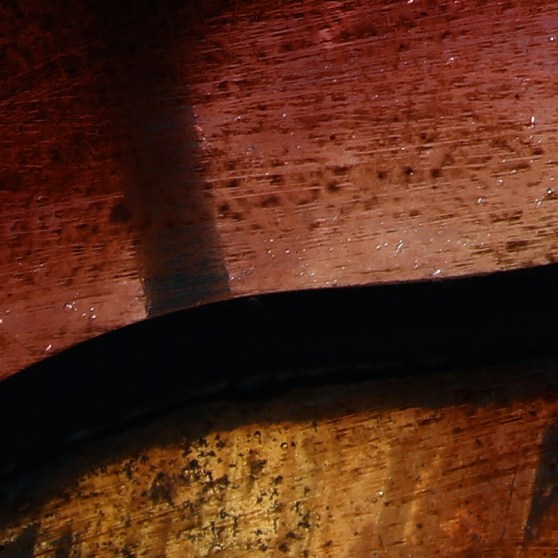
Some 140+ images later, interesting an revealing detail of the quality of the glass, nature of the painting, together with the structure of the windows became more apparent.  I rather like the images and undoubtedly, these abstract, out of context, colour panels could be displayed in their own right.


The glass clearly shows its age with impurities, inclusions and many vesicles throughout:

Fine relieving (removal of paint from the surface of the glass prior to firing) formed the final process.  In this case needlework was used:

The painting at times is far more akin to pen and ink, with precise, controlled lines often not more than 1mm thick, providing the patterns and textures:

800x800 DCP_8458

In close-up, the order of events can also be identified particularly when looking at pale washes of colour… bold lines – shading – colour – dry brush:

800x800 DCP_8451c

Beyond the glass, the quality of the metalwork is exquisite, with the calmes that hold together the pieces of glass being soldered together very cleanly and precisely:

Calmes.jpg


Creative interpretation


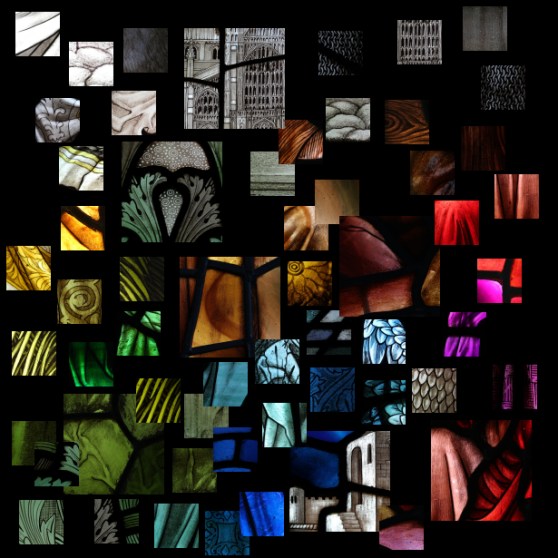
This micro-project also presented the opportunity to be ‘creative’ with the exquisite artwork… undoubtedly Henry Holiday will be turning in his grave.

12x12 composition (low res)

Contemporary Tiles

NEW Composition (low res)

Abstract Tiles