Project Development

St. Edward’s School Chapel


On entering the building, to the right there is a small Memorial Chapel that adjoins the bell tower and spire.  The east window therein comprises three lights dedicated to the memory of William Robert Weatherley who attended St, Edward’s School from 1922-1927 and was a Senior Prefect.  After St. Edward’s, he attended Pembroke College, Oxford.

Pembroke College Record (William Robert Weatherley) - (low res)The Pembroke College Record 1933-1934 records the dedication of the window by the Master of Pembroke College, Rev. Frederick Homes Dudden (page 9):

On 5 December 1933 the Master dedicated a window in the memorial chapel of St. Edward’s School, Oxford, to the memory of William Robert Weatherley, who was in residence from 1927 to 1930, and whose death at so early an age was a shock to the many who knew him well and appreciated his delightful personality.

The memorial window states Ob. 1930 – obijt mortem, meaning, he died 1930, at the age of just 21 years.

St. Edwards - William Weatherley (low res)

Shot at 85mm, using the Canon EF 85mm f/1.2L II USM, and presented above with the actual spacing of the three lights, this window highlights a drawback of capturing such a scene in just one photograph: while the final image is an acceptable 15.8MP, each individual light is little more than 600 pixels wide – a tragically low resolution for such an impressively detailed and lavish work of art.  The colour and detail of the feathers in the angel’s wings is worthy of far more attention and warrants in itself a return visit.

Notwithstanding, the removal of fifteen support bars dramatically protracted the editing time, adding almost an hour per bar to the finished work.

St. Edwards - William Weatherley (detail)


Addendum:  Happy to have completed this work, I did a final check through the batch of images only to realise that the final skin tones were far too dark and too saturated.  With tree shadow working across the window from left to right, it has been difficult to balance the tone and colour of the angels, but I have now re-edited the skin tones to something far more in keeping with the actual window.

St. Edwards - William Weatherley - RE-EDITED(low res)

William Weatherley window (Artist unknown, 1933) St. Edward’s School Chapel
Project Development

Plain English & the Chapel of St. Nicholas


Feedback on my initial Work in Progress Portfolio suggested  the ‘it may be worth exploring the possibility of showing details or fragments in order to communicate other aspects of their importance.’ 

While I am confident that the Plain English Campaign could host a symposium on English language and its use in art critique, I rather relished investigating this suggestion and hope that my interpretation of its meaning is true to the author.  To that end, I have investigated the finer detail of the stained glass in order to demonstrate the various associated processes – something already done in part, but perhaps overlooked, during Module 1: Three dimensions? in which I demonstrated the unexpected three-dimensional nature of parts of some of the lights, with two layers of painted glass providing greater depth as well as increased saturation to areas of the installation:

800x800 DCP_8432d

With illumination being so critical to stained glass window photography, I conducted numerous visits to the Chapel of St. Nicholas covering most lighting conditions, (overcast; partially cloudy, clear skies; morning sun; midday sun; afternoon sun and evening sun). in order to find the most opportune time to demonstrate best the macro world of stained glass.  Countless hours of lab time spent examining assorted geological samples during my graduate studies taught me that oblique illumination is typically best for revealing the rather more hidden stories.  Stained glass windows typically found on all walls of places of worship – certainly the case for the Chapel of St. Nicholas, but on a clear day, the late-afternoon/early-evening sun resulted in the most revealing illumination of the north and south aspects.

Some 140+ images later, interesting an revealing detail of the quality of the glass, nature of the painting, together with the structure of the windows became more apparent.  I rather like the images and undoubtedly, these abstract, out of context, colour panels could be displayed in their own right.


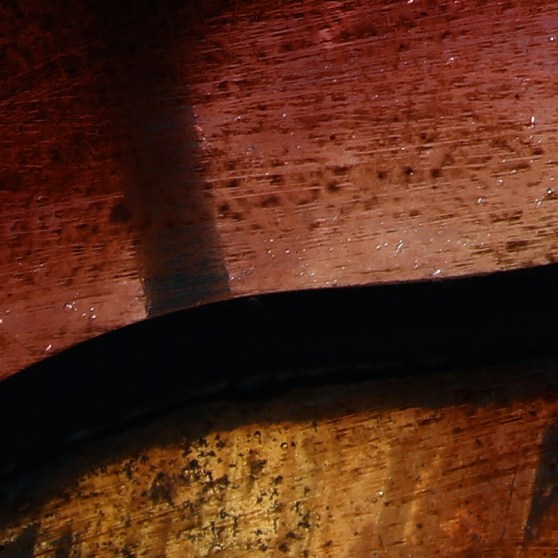
The glass clearly shows its age with impurities, inclusions and many vesicles throughout:

Fine relieving (removal of paint from the surface of the glass prior to firing) formed the final process.  In this case needlework was used:

The painting at times is far more akin to pen and ink, with precise, controlled lines often not more than 1mm thick, providing the patterns and textures:

800x800 DCP_8458

In close-up, the order of events can also be identified particularly when looking at pale washes of colour… bold lines – shading – colour – dry brush:

800x800 DCP_8451c

Beyond the glass, the quality of the metalwork is exquisite, with the calmes that hold together the pieces of glass being soldered together very cleanly and precisely:

Calmes.jpg


Creative interpretation


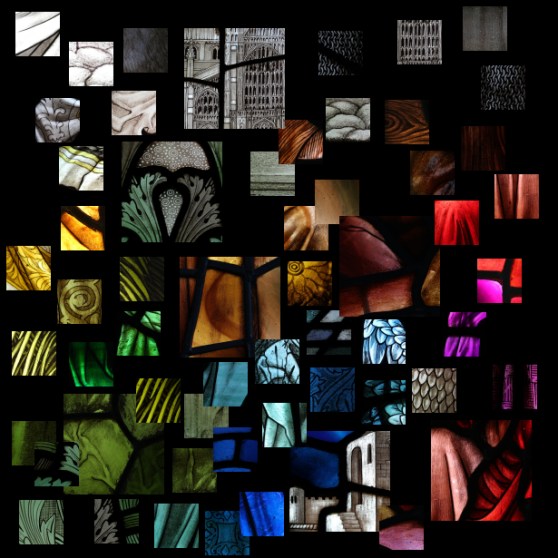
This micro-project also presented the opportunity to be ‘creative’ with the exquisite artwork… undoubtedly Henry Holiday will be turning in his grave.

12x12 composition (low res)

Contemporary Tiles

NEW Composition (low res)

Abstract Tiles

Vanishing History

“Gang of 12-year-olds” smash stained glass windows


A gang of boys aged around 12 are thought to be responsible for a spate of incidents at St Peter’s Church in Hale which has damaged stained glass windows that date back to the 19th century.

The first incident took place on Saturday 21st July (2018), when 12 or 13 small panes of glass in a leaded window were smashed in the vestry.

Hale 02

A more significant incident then followed on the night of Thursday 26th July, when a further six or seven panes were smashed in the vestry and stained glass windows on the North Aisle were damaged.  Damage to the vestry was sufficient to warrant boarding-up all windows.  Fortunately these windows were protected by toughened glass, which sustained most of the damage.

Hale 01

A further incident took place on Friday afternoon, when police were called to the church during a rehearsal for a wedding.

Police confirmed to us they had been called out 4.40pm to reports of youths throwing items at the church’s windows, but the perpetrators had fled.  They did however confirm that the church was now getting “passing attention” by local police officers.

Hale 03Sadly, there is no photographic record of the damaged pre-Raphaelite lights depicting the Angels of Praise and Thanksgiving with musical instruments, which will hinder restoration work.  They were part of a series by the firm of Heaton, Butler & Bayne, that includes the two lights shown to the left.

M2 Wk5: Three ‘Surfaces’

Week 5: Independent Reflection


The majority of my work is audience-driven, with photographs taken for the school being used in social media, school magazines and placed on display around the school.  My research project is likewise audience-driven, with my intentions being to generate money (selfishly) but also draw the public into Oxford’s chapels through exposure to my images.

It is my hope and intention for the project to be exhibited at the Aidan Meller Gallery, the longest established art gallery and leading dealership in Oxford.  Sadly I have been unable to visit and discuss this possibility in recent weeks as the gallery is closed in readiness for a major project.  This is a new venture for me and I have no idea how interested a fine art gallery would be in my work.  However, in my favour is the fact that it hosted an exhibition of Pre-Raphaelite Drawings in summer 2017.  It was a presentation from a discovery of lost works found in Oxford that included original works on paper for sale from John Everett Millais, William Holman Hunt and John Waterhouse.  Alongside original drawings created for Stained Glass by the two leading manufacturers of the 19th Century, Heaton, Butler & Bayne and Powell & Sons.

I would have no concern in allowing a curator to influence the reading of my work: I am confident that an art dealer such as Aidan Meller is far better placed to understand the best ways to display, promote and sell my images.


Experience of the week’s activities:  As anticipated, my professional work has continued to thwart my project development and During Week 5, the only photographic work I carried out was at the National Athletics Championships in Birmingham. Managing a team of competitors does conflicts with and limit the time I can commit to taking photographs. While I do have to be wary of GDPR, the organisers have a simple and effective policy on photography:

Attendance at the Alexander Stadium implies permission for photography at these events. Any person wishing NOT to be photographed at this event is advised not to attend.

This policy makes very good sense since parents and schools are all, typically, keen to use images of their successful children. However, the nature of athletics is that an image of one child will likely include multiple other children, so gaining permission to use such an image would otherwise prove an impossibility.

For the first time, I tried to capture some of the UK Athletics Officials in the context of their work – not always the easiest of tasks since they can often by isolated from the actual action. However, the recorder and fault judge for the javelin competition was well placed to tie in with a competitor about to take a throw, resulting in a less usual, yet fairly pleasing composition (I would like to have cropped more tightly on the Official, but that would have precluded important detail in the competitor).

Project Development

Chapel of St. Nicholas


When photographing the Chapel of St. Nicholas in early July, I was undecided which light would be best to edit, so with conditions being ideal, I photographed a selection.

The completed image below strikes me as being rather dark, although as I recall, this was the case particularly in comparison with Fight the Good Fight, for example.  I have yet to take a copy to the chapel for comparison and possible re-editing.

One omission from most of the windows or lights that I edit is the inscription.  This window was given by the parents after the death of their son.

The inscription reads:

In Loving Memory of EDWARD HORACE PERCIVAL, who died at Summer Fields March 9, 1900, added 14.

The boy in the image is apparently a likeness of Edward.

St. Nicholas - Be Ye Kind One to Another (low res)

Be Ye Kind One to Another (Henry Holiday, 1901) Chapel of St. Nicholas

Project Development

The Chapel of John the Baptist – St. John’s College


IMG_7058 (edited)I have just revisited The Chapel of John the Baptist at St. John’s College in order to understand better the text scratched into the glass at the top right of the right hand light.  The image to the left is deliberately over-processed in order to make the lettering as clear as possible – and at last, fully understandable.

In combination with the original image, taken from a higher vantage point, it is possible to identify the characters below the twisted cobweb.   As a result, it has been possible to interpolate all of the text, as shown in this second image.  Consequently, I can conclude that the writing states BOSSANYI 1944 (followed possibly by -195) LONDON.

IMG_7058 (edited with text)The two lights are replicas of a pair made by Bossányi for a 1944 commission, which reside in the Zouche Chapel of York Minster.  Bossányi retained the copies for permanent display in his studio to show prospective clients.

Further research has revealed additional information on the context of the light: this shows St. Francis of Assisi with the leper, who, according to the story, was restored to health and reconciled to faith by the saint’s ministrations, and who appeared to Francis in a vision as his soul ascended to the heavens.  The image depicts Francis’ complete engagement with the man’s sufferings, above which the Holy Spirit hovers in the form of a dove.


Project Development

Chapel of St. Nicholas – rose tinted glasses?


St. Nicholas - Be Ye Kind One to Another GIF.gifToday afforded me a moment to call in on the Chapel of St. Nicholas in order to compare my rendering of Be Ye Kind One to Another with the installation itself.

The concerns I had about the darkness of my image were well founded, and interestingly I had again oversaturated the reds and browns (as was the case with the Harris Manchester College Chapel light Courage).  Perhaps there is some truth to the  rose tinted glasses idiom?!

Such changes were quite easy to correct as was some fine detail in the colouring of the text and punctuation.  The animated GIF to the left demonstrates these subtle changes in a 2-second cycle (but does sacrifice quality):

There is a lot of quality loss in a GIF, so below is a JPEG of the final re-edited image:

St. Nicholas - Be Ye Kind One to Another v2 (low res).jpg

Be Ye Kind One to Another (Henry Holiday, 1901)

Project Development

Contemporary Tiles animated


While being creative with Henry Holiday’s glasswork, I was keen to see if there were any other ways that I could put to use the concept… here’s one:

Contemporary Tiles

Project Development

St. Peter’s-in-the-East – Planning visit


A window of opportunity enabled me to return to St. Edmund Hall today, for a preliminary visit to their library (formerly St. Peter’s-in-the-East), having secured provisional permission to take photographs, thanks to the support of James Howarth, Librarian at St. Edmund Hall.

While technically a church, as it is deconsecrated and forms part of the St. Edmund Hall campus, I am happy to include reference to it within my research project.

St. Peter-in-the-East is said to be named after the church of S. Pietro in Vincoli in Rome and is named in the Domesday Book (c.1085). It was used as the student chapel for St. Edmund Hall until the chapel was built on the College grounds in 1682.  The church was closed as a place of worship in 1965 and reopened as the College library in 1970.

Once again, aided by a 3D tour of the former church prior to the visit, I was prepared for some of the surprise that was in store… photography can be difficult enough within chapels when only having to negotiate pews, however in a building now filled with bookcases, tables and computer desks, this location will prove quite demanding.  To further confound things, I will only be allowed to photograph the site outside the Oxford University term dates.  This is likely to result in the work not forming part of my Module 3 portfolio.

Notwithstanding, I set about surveying the numerous windows – all magnificently cleaned and restored in readiness for the church becoming the library of St. Edmund Hall.  The location of furniture presents quite a headache for most lines of sight.  I am most optimistic about my chances in photographing the East Window, however, this is likely to necessitate me mounting my tripod on desk – something that may be frowned upon in a library.

Detail information about and from guide book here.

Images to follow.

Project Development

The Chapel of St. Edmund


Possibly the smallest chapel in Oxford, St. Edmund Hall’s chapel was consecrated for use in 1682 and dedicated to St Edmund.  The stained glass windows were installed a couple of centuries later by Messrs Clayton and Bell.  Sadly, where photography is concerned, choice over stained glass windows was limited: much of the glass suffered from close proximity to other buildings or dense foliage, making it incredibly dark, or resulting in a mottled appearance.

DCP_8561 (low res)The east window was work of the famous artists and designers, Sir Edward Burne-Jones and William Morris, and was inserted in 1865. It is the earliest example in Oxford of their stained glass work. The arrangement of the window was designed by Philip Webb, who also designed the pattern work. Fortunately, the main light within the East Window (by Burne-Jones) was lit uniformly and lent itself to convenient shooting, as there was the full length of the nave to use.

The east window demonstrated very high contrast, with significant area proving difficult to resolve in anything more than black.  It is also a window that has not been cleaned recently, showing much build-up of dark grime.

St. Edmund Hall - Ecce Agnus Dei (cut out) UPDATED PNG (low res)

Crucifixion (Edward Burne-Jones, 1865) The Chapel of St. Edmund

Ecce Agnus Dei qui tollit peccata mundi
Behold, the Lamb of God, who takes away the sins of the world!
John 1:29

Shot at 220mm, using the Canon EF 100-400mm f/4.5-5.6L IS II USM lens, at the now standard aperture of f/8.0, there was only a small amount of perspective distortion to correct in the final image.